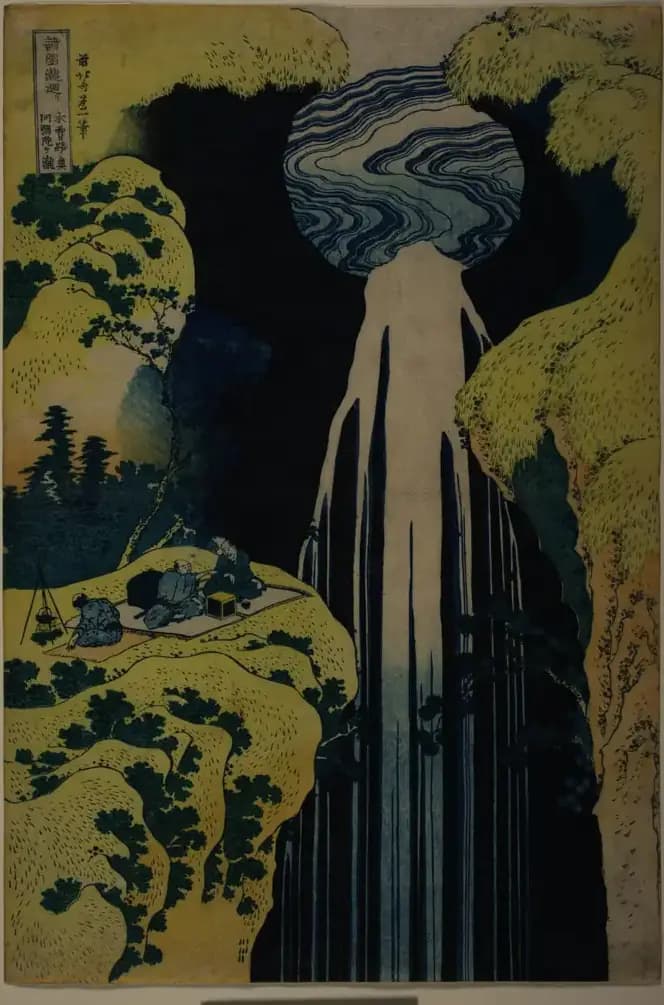
A source made perfectly round
The circular pool is the print's visual shock. Real water does not announce itself with such an exact outline, but the form makes source, depth and motion immediately legible. Dark blue gathers at the rim while pale currents turn inside before spilling downward.
Water changes its grammar
Below the pool, one stream divides into white ribbons edged in blue. The flow widens, narrows and breaks around rock before leaving the sheet. Hokusai gives every waterfall in the series a distinct design, using contours and repeated marks to translate movement into print.
Travellers beside the impossible
Small visitors sit, stand and gesture on the cliff. Their hats, bundles and meal make this a stop along the Kiso road rather than an abstract fantasy. Yet their calm presence also sharpens the pool's strangeness. Tourism and visual invention meet without needing the landscape to behave literally.
The viewpoint is part of the invention
At the top, a round pool opens like an eye before water escapes through its narrow lower edge. Hokusai combines a downward view into the basin with a frontal view of the falls, something no single standing position could provide. The distortion is purposeful. It lets us understand both the source and the descent in one vertical design.
Small visitors on the bank appear to encounter a real destination, but blue outlines turn water into a powerful graphic shape. The falls divide, curve and reunite while surrounding rock remains comparatively still. Hokusai’s series treated famous waterfalls as distinct personalities rather than repeating one formula. Here the circular source gives Amida a visual identity that can be remembered as readily as its name.
Sources and further reading
- The Metropolitan Museum of Art collection searchObject records, title and series context.
- British Museum collection searchInstitutional impressions and waterfall-series details.