A composite wilderness
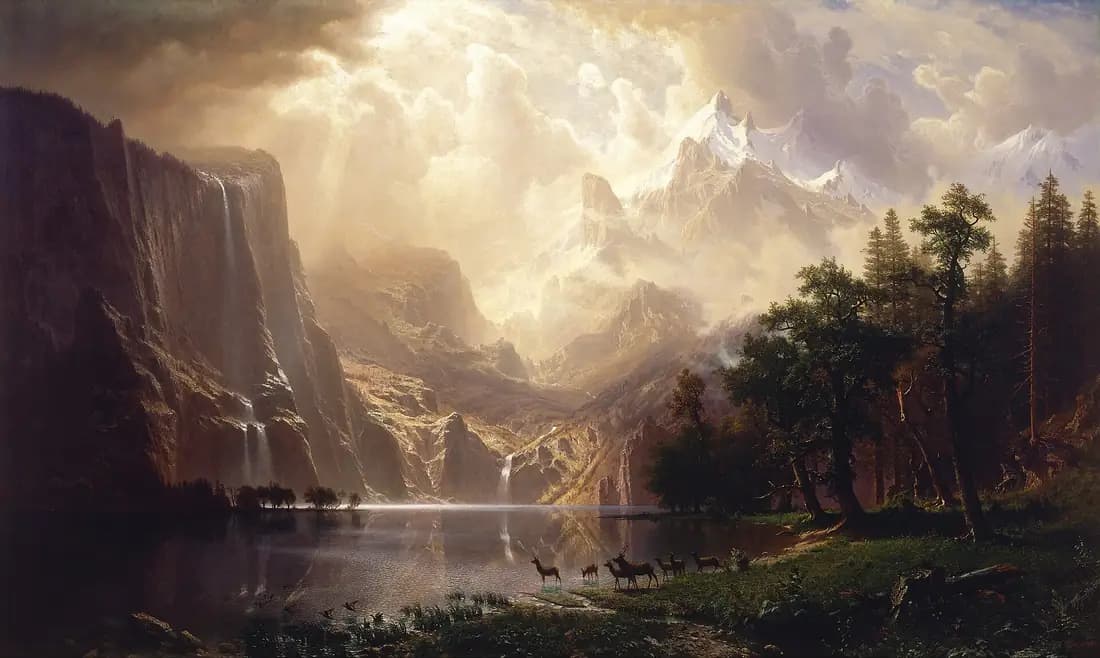
Bierstadt gathered sketches during western journeys and combined them in a New York studio. The painting's elements evoke the Sierra Nevada without identifying one exact lake and waterfall. Composition serves abundance: every direction offers snow, water, forest, rock or animal life.
Light stages the discovery
Dark foreground trees work like curtains around a bright interior. Sun catches waterfall mist and distant slopes, while the lake doubles mountains in reflection. Deer occupy the lower edge as signs of peaceful life, making the landscape appear untouched and available to the viewer.
The politics inside paradise
Such paintings reached eastern audiences during rapid settlement and dispossession in the West. Their apparently empty wilderness excluded Indigenous histories and ongoing presence. Recognising that context does not cancel the painted light or scale. It clarifies how aesthetic wonder could support a national story in which land seemed waiting to be claimed.
A landscape that first travelled as spectacle
Bierstadt exhibited the painting in Europe before it entered an American collection. Its luminous lake, deer and snow peaks offered distant audiences an idealised California wilderness at monumental scale. Like his other western panoramas, it was built from studies but arranged in the studio, where geography could be intensified into a single commanding encounter.
The light leads us in stages. Dark trees frame the foreground, the lake opens as a reflective middle and mist carries the eye toward the peaks. Deer provide life without challenging the impression of untouched land. That apparent emptiness is historical construction, not fact. Indigenous communities had long relationships with these landscapes, even when nineteenth-century paintings presented western nature as newly available for national admiration and expansion.
Sources and further reading
- Smithsonian American Art MuseumObject, field studies, studio construction and exhibition.
- The Metropolitan Museum of Art, BierstadtInstitutional context for western landscapes and nineteenth-century expansion.