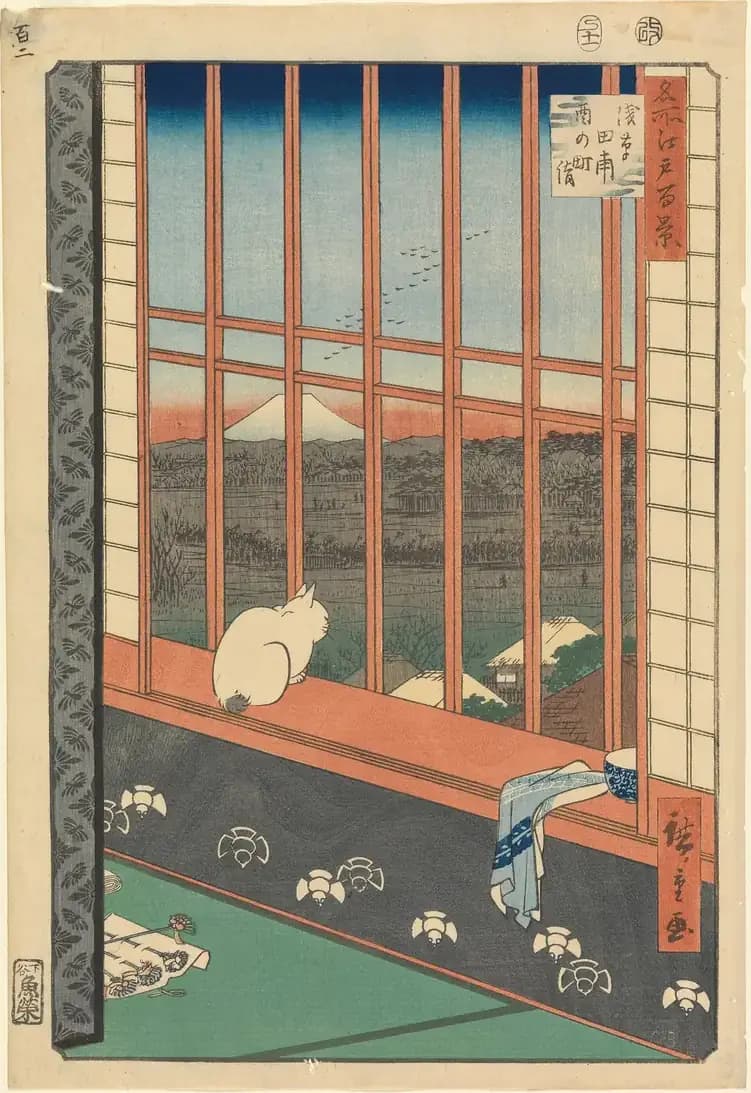
Edo seen from indoors
Most famous-place prints place the viewer directly in a street or landscape. Here a window frame, ledge and domestic objects announce an interior. The cat faces away from us, becoming a small stand-in for looking. Its ears point toward the view while its curved back anchors the empty room.
Clues to an absent person
Hairpins lie beside a folded cloth, and a bowl with water sits near the edge. These details identify a woman's quarters in the Yoshiwara district without showing her. Their intimacy contrasts with the broad fields outside and invites a story that Hiroshige never completes.
Festival movement in the distance
Across the paddies, people travel toward the Tori-no-machi festival at Ōtori Shrine. Fuji rises small but unmistakable on the horizon. Near, middle and far distance become three scales of attention: the tactile ledge, the moving festival crowd and the mountain that makes the city part of a larger landscape.
A cat looks beyond the pleasure quarter
The cat occupies a windowsill in Yoshiwara, Edo’s licensed pleasure district. It looks toward distant rice fields and Mount Fuji while hairpins, a towel and a bowl hint at a room behind us. By withholding the human resident, Hiroshige makes the interior feel occupied but private. The animal becomes our companion at the threshold.
The view also joins two seasonal observances. Decorative kumade rakes refer to the Tori-no-machi festival, while a procession crosses the fields in the distance. Near objects are cropped and specific; the landscape is broad and pale. That contrast lets one sheet contain domestic detail, urban entertainment, agricultural land and sacred mountain, all organised by the direction of a cat’s gaze.
Sources and further reading
- Chester Beatty collectionInstitutional impression and object record.
- The Metropolitan Museum of Art collection searchRelated impressions and iconographic context.