An Arctic assembled from evidence
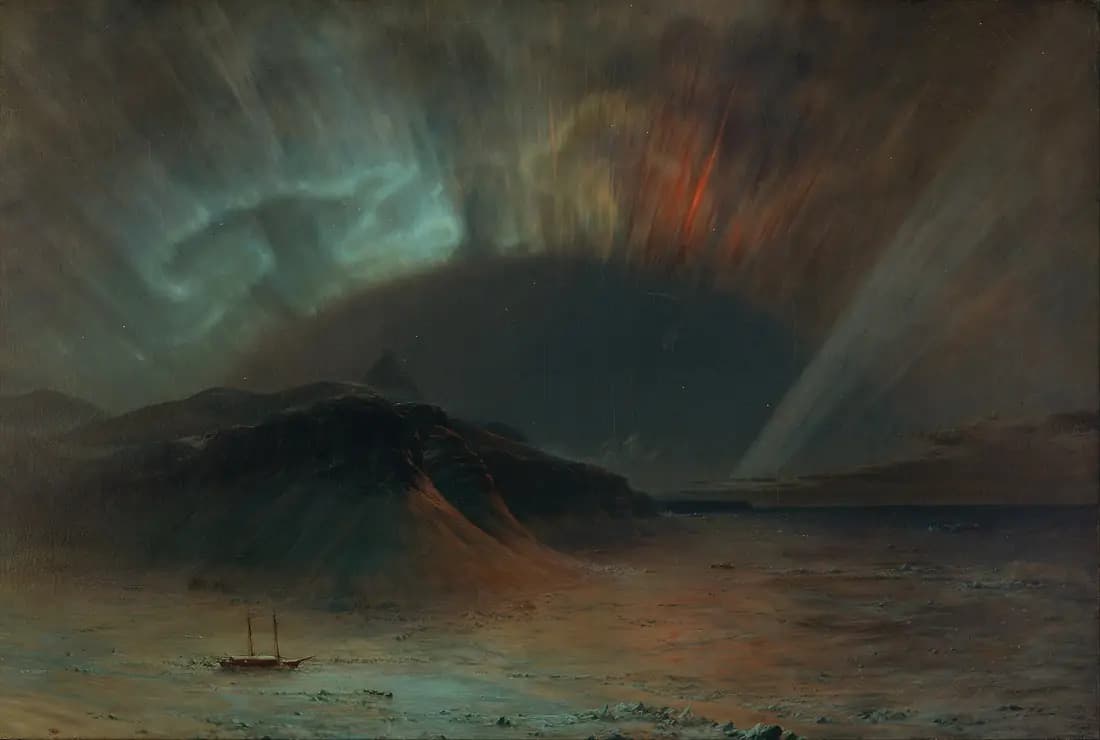
Explorer Isaac Israel Hayes lent Church sketches from his 1860-61 expedition and advised him on the landscape. The small ship United States and the dark profile of Mount Church connect the dramatic sky to Hayes's actual journey, even as Church reshaped those materials into a studio composition.
Painting a moving light
The aurora bends in pale green bands across stars, mirrored by cracks and reflections below. Nineteenth-century scientists were still debating its causes. Church makes it legible without making it static: the arc seems to spread beyond the frame while its light touches ice unevenly.
A nation read into the sky
The painting was completed as the Civil War ended. Viewers have interpreted its darkness, red details and emerging light as signs of national crisis and possible renewal. Church did not leave a key fixing that meaning. The historical moment matters, but so do the painting's other tensions: exploration and entrapment, evidence and invention, darkness and unstable illumination.
A frozen ship beneath a moving sky
The aurora curves above a landscape locked into hard shapes. Ice, cliff and trapped ship seem motionless, while coloured light bends across the sky like something alive. A dogsled near the vessel offers the smallest sign that escape remains possible. Church makes a natural phenomenon carry the scene’s movement because human travel has stopped.
The explorer Isaac Israel Hayes supplied sketches from his Arctic expedition, but Church transformed that evidence into a composition with contemporary resonance. The work was painted during the American Civil War, and viewers could connect its ominous red light and isolated ship to national danger. Scientific curiosity, friendship and political anxiety overlap, without reducing the aurora to one fixed symbol.
Sources and further reading
- Smithsonian American Art MuseumObject, Hayes expedition, Civil War context and visual analysis.
- Smithsonian American Art Museum, Frederic Edwin ChurchArtist biography and landscape context.