Not every bird is safe
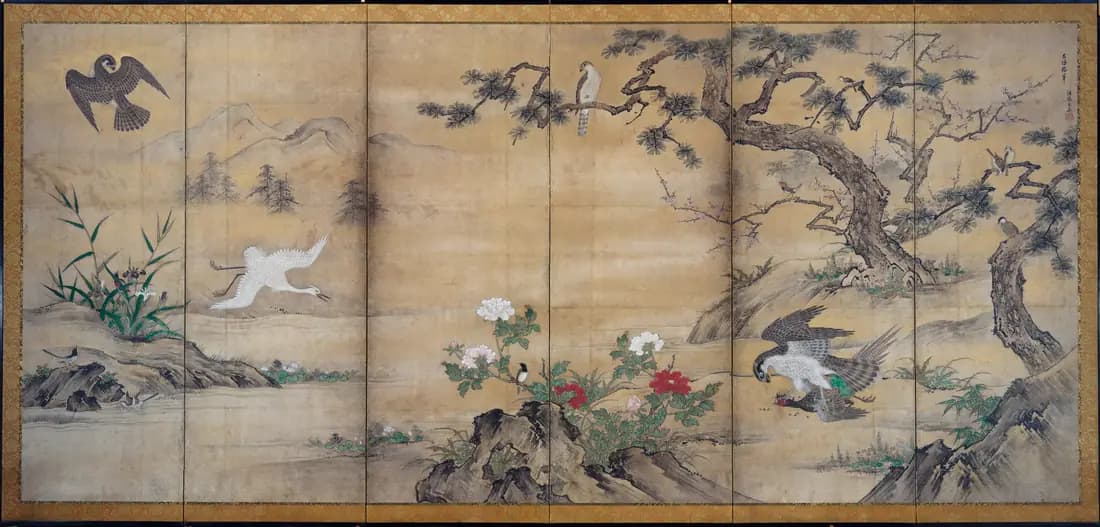
At first the screen offers familiar signs of a peaceful landscape: distant mountains, flowering plants, rocks, water, and a pine spreading across several panels. Then the relationships sharpen. A hawk perches in the tree, another flies above, and a raptor on the ground has caught its prey. Smaller birds scatter through the open gold.
The Cleveland Museum explains that military patrons often requested predation inside otherwise tranquil scenes of birds and flowers. Hawks carried associations with martial ability. Beauty and violence therefore occupy the same landscape by design, not because a later viewer has discovered a hidden accident.
Gold makes distance behave differently
The mountains at the left are pale and remote, but there is no continuous blue sky behind them. Gold leaf provides atmosphere, empty space, and reflected light at once. Dark ink can describe a branch with a few decisive changes of pressure, while mineral colors make flowers and plumage hold their place against the shining ground.
A photograph fixes the gold at one brightness. A folding screen in a room would not stay so still. Its angled panels caught light differently as a viewer moved, making birds, branches, and blank passages alternately advance and recede.
One half of a journey through the seasons
This screen belongs to a pair whose landscape progresses from right to left through the year. Across both works, spring plum gives way to summer irises, autumn bellflowers, and late peonies. Birds help animate that movement: ducks occupy the water, while peafowl and raptors establish very different kinds of encounter.
Showing this separately cataloged half preserves the full width and folding rhythm of one object. The absent companion still matters to its meaning. The screen is a chapter in a seasonal sequence rather than a self-contained snapshot of one afternoon.
An attribution, not a simple signature
The museum attributes this half to Kano Shōei, a painter in the Kano school. The paired record also carries inscriptions connecting the screens to Kano Eitoku, but those inscriptions are later attributions rather than artists' signatures. That distinction matters because a prestigious name written on an old object does not automatically settle who painted it.
The careful wording does not make the screen less rewarding to look at. It makes its history more honest. Workshop traditions, family lineages, and later judgments all helped determine how such large decorative paintings were remembered, while the birds still conduct their drama across six physical panels.
Sources and further reading
- Cleveland Museum of Art, single screenExact object, attribution, format, dimensions, predation, and visible description.
- Cleveland Museum of Art, paired screensSeasonal sequence, the companion screen, bird symbolism, and the attribution inscriptions.
- Cleveland Art, Discovering Japanese ScreensThe museum's institutional publication on viewing and understanding Japanese folding screens.