A disaster fills the horizon
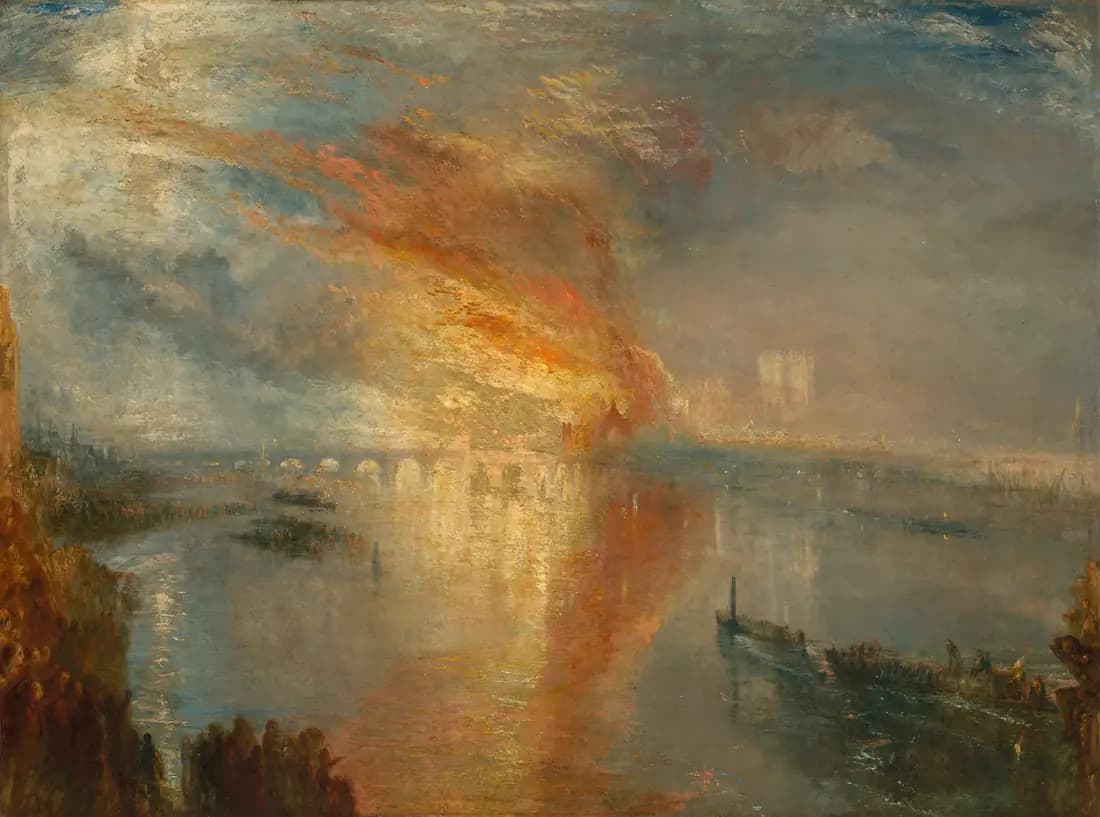
Flame, smoke, and reflected light fuse into one broad orange mass. Westminster's buildings are barely stable shapes inside it. Turner places darker spectators along the near bank and small craft on the river, so the human scale of the scene survives beneath the spectacle.
The brightest reflection does not sit neatly below the fire. It spreads and bends through gray water, making the Thames feel as unsettled as the sky. Color carries the force of the event before architecture can explain where we are.
Boats expose the practical emergency
The Houses of Parliament caught fire on 16 October 1834. The Cleveland Museum notes that low tide hindered pumping and slowed steamers towing firefighting equipment. The vessels at lower right are therefore more than picturesque details: they are moving toward work that the river itself made difficult.
Crowds gathered along the banks to watch. Turner was among the witnesses and made quick sketches of the fire; his two major painted versions adopt different viewpoints. This picture joins public spectacle and urgent labor without pretending that the spectators share the danger equally.
Witnessing was only the beginning
Turner did not simply enlarge one sketch. The museum explains that he heightened the flames, using the actual fire as a starting point for a scene about human vulnerability before destructive natural forces. The buildings burn, but fire, air, and water become the painting's largest actors.
That transformation borders on abstraction. Swaths of pale paint blur smoke into cloud, while sharper accents pull a boat, tower, or figure briefly back into view. Recognition keeps emerging from material that seems ready to dissolve it.
A second painting changes the view
Turner painted two major versions. Cleveland's picture looks downriver from the southeast bank; the Philadelphia Museum's version faces the fire from across Westminster Bridge. The pair shows that no single position could contain the event for him.
Here the bridge does not dominate. Open water becomes the distance between those watching and those approaching the blaze. Return to the boats after looking at the fire, and the painting changes: its vastness is measured by a few dark marks that still move toward the light.
Sources and further reading
- Cleveland Museum of Art collection recordExact work, dimensions, fire, low tide, boats, amplified flames, viewpoint, and second version.
- Philadelphia Museum of Art, related versionTurner's eyewitness studies and the distinct viewpoint and architecture in his other painted version.