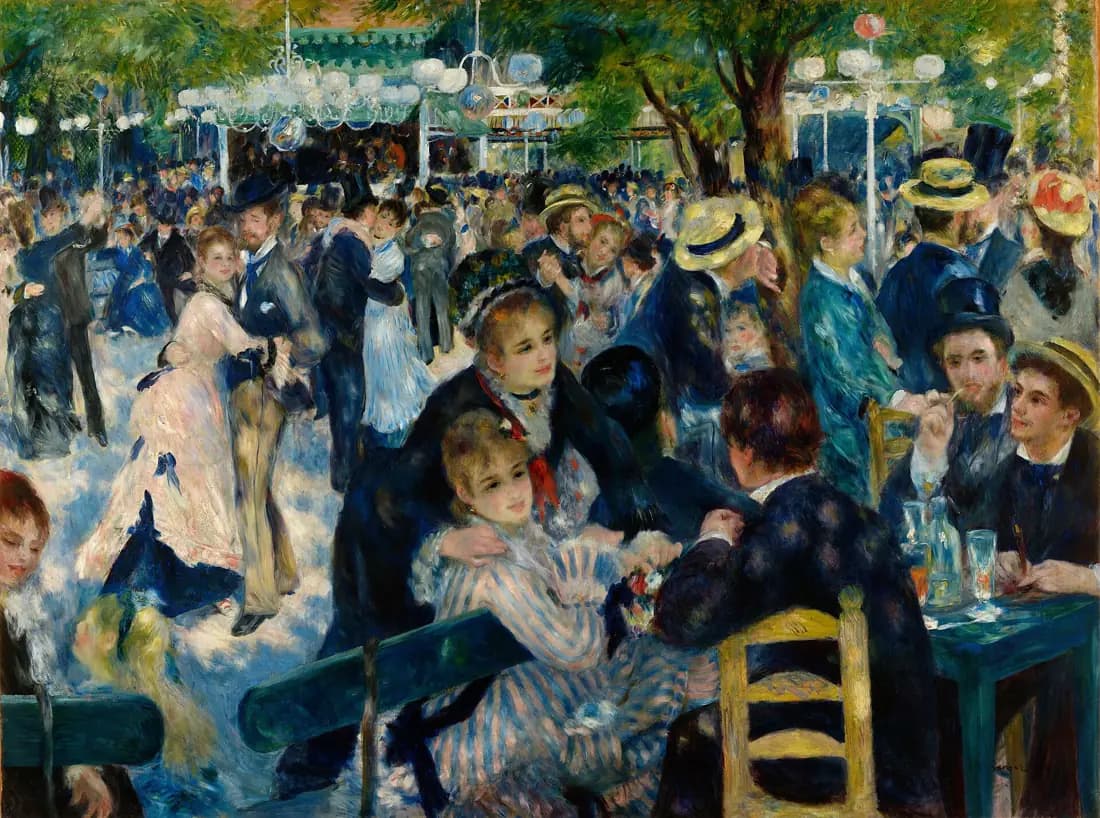
A Sunday dance in Montmartre
The Moulin de la Galette was a popular dance garden on the Butte Montmartre, then still more village-like than central Paris. On Sunday afternoons, visitors could eat, drink and dance until midnight. A small orchestra played from a platform while acacia trees filtered the daylight above the courtyard.
Renoir does not give us one principal dancer. Conversation, flirtation, watching and movement overlap. The foreground table offers a place to enter, then faces and hats pull the eye through a crowd that seems to continue beyond every edge.
Friends, artists and working women
Several figures were Renoir’s friends. The critic Georges Rivière sits at the table; the painters Franc-Lamy and Norbert Goeneutte appear nearby. Other models included artists, a Cuban painter, local seamstresses and young working women whom Renoir paid to pose.
Knowing their names does not turn the scene into a group portrait. Renoir rearranged individual sittings into a shared atmosphere. The painting’s subject is sociability itself: the constant exchange of glances, remarks and partners across a public place.
Light that refuses to sit still
Sunlight passes through the leaves in pale blue, pink and gold patches. Artificial light joins it beneath the trees and covered areas. Instead of modelling every body with one stable source, Renoir lets light scatter across jackets, dresses and faces as the crowd moves.
That flicker contributed to criticism when the painting appeared at the 1877 Impressionist exhibition. Forms seemed to dissolve. Today the same instability is central to its appeal: the whole canvas behaves less like a posed photograph than a memory of being inside a busy afternoon.
A masterpiece saved by another painter
Gustave Caillebotte, the painter of Paris Street; Rainy Day, acquired the canvas soon after it was shown. He collected works by fellow Impressionists and arranged for his collection to pass to the French state. The bequest was controversial, but accepted works helped establish what became a foundational public collection of Impressionism.
The painting therefore connects two consecutive Daily Art stories. Caillebotte painted the rain-darkened modern city; he also helped preserve Renoir’s bright Montmartre crowd for the public.
Sources and further reading
- Musée d’Orsay collection recordObject details, exhibition history, light and contemporary reception.
- Musée d’Orsay 150th-anniversary studyThe venue, its visitors and identified models.
- Musée d’Orsay, Caillebotte’s collector portraitCaillebotte’s ownership and bequest of the painting.