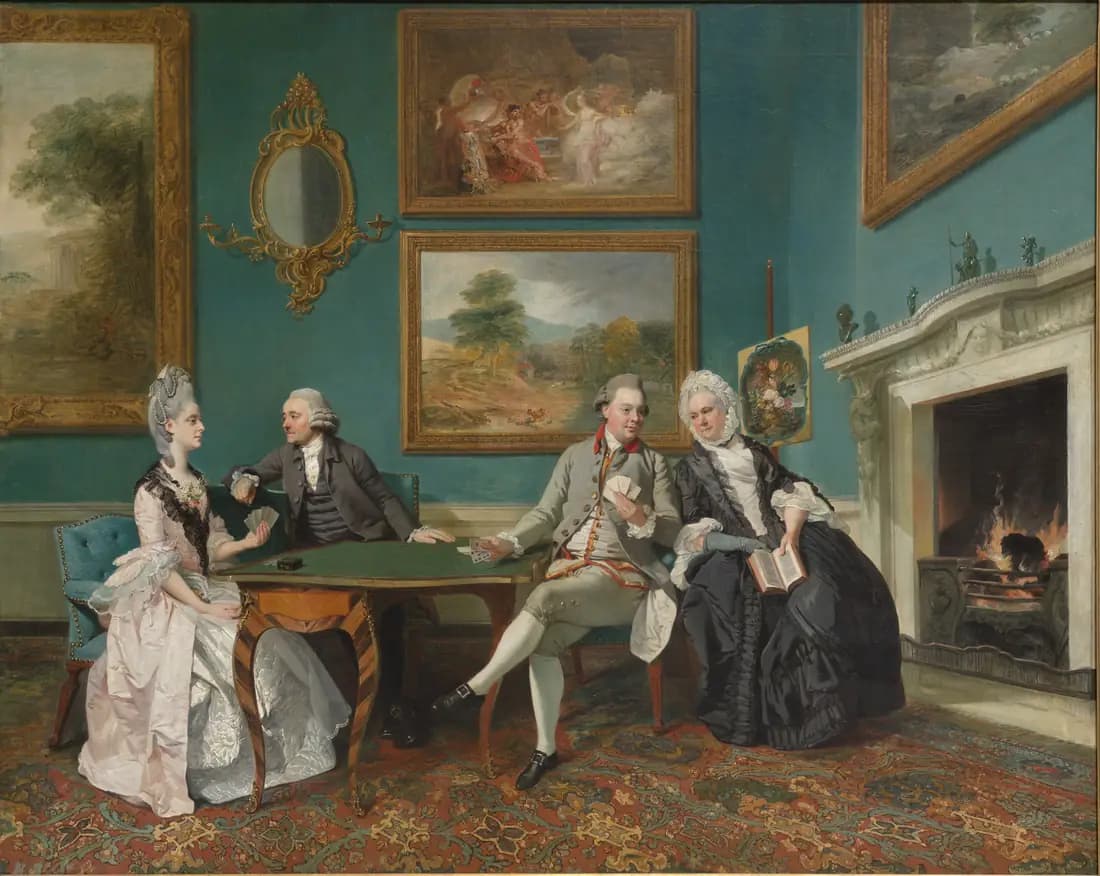
A portrait pauses during play
Four figures gather around a green card table rather than lining up to face the viewer. The woman at left holds her cards toward the man beside her. Across the table, a younger man holds cards over the green surface while the woman near the fire looks down at an open book. Glances and gestures carry the action across the room.
The Cleveland Museum describes them as father and daughter, mother and son, strategizing over the next hand. Small shifts in posture keep the family connected without making the scene look spontaneous. Every chair, hand, and glance has been composed to turn a formal likeness into an event.
Mourning enters quietly
The card game is sociable, but the clothing records a recent loss. Cleveland identifies the parents' black clothes as full mourning and the siblings' mauve, white, and gray as lesser mourning. Grief appears through social convention rather than an overt scene of sorrow.
That coexistence matters. Play does not cancel bereavement, and mourning does not freeze the family into solemn isolation. Zoffany presents people continuing to live together within rules governing dress, generation, and conduct.
The drawing room makes an argument
Blue-green walls, a patterned carpet, carved furniture, a gilded mirror, a marble fireplace, and numerous paintings surround the figures. The room offers an inventory of refinement, but the museum notes that it is idealized rather than an actual interior at Sherborne Park.
Cleveland's curator explains that the pictures within the picture were also invented. History painting hangs high, landscapes occupy the center, and a flower image appears on a fire screen. Zoffany uses the family's imagined collection to advertise both their taste and his ability across artistic genres.
Informality was carefully designed
This kind of informal group portrait is called a conversation piece. The genre flourished in eighteenth-century England because it could present family relationships through shared activity while also showing the interiors, possessions, and manners by which sitters wished to be known.
The painting therefore records desire as carefully as appearance. The family wanted the ease of private life and the polish of public status to fit in one image. Return to the card table after scanning the room: the modest game becomes the device that makes all this display seem natural.
Sources and further reading
- Cleveland Museum of Art collection recordExact painting, date, medium, dimensions, card game, family group, mourning clothes, conversation-piece genre, and idealized room.
- Cleveland Museum of Art, The Conversation PieceCuratorial account of the family's gestures, invented pictures, room display, genre hierarchy, provenance, and Zoffany's conversation pieces.