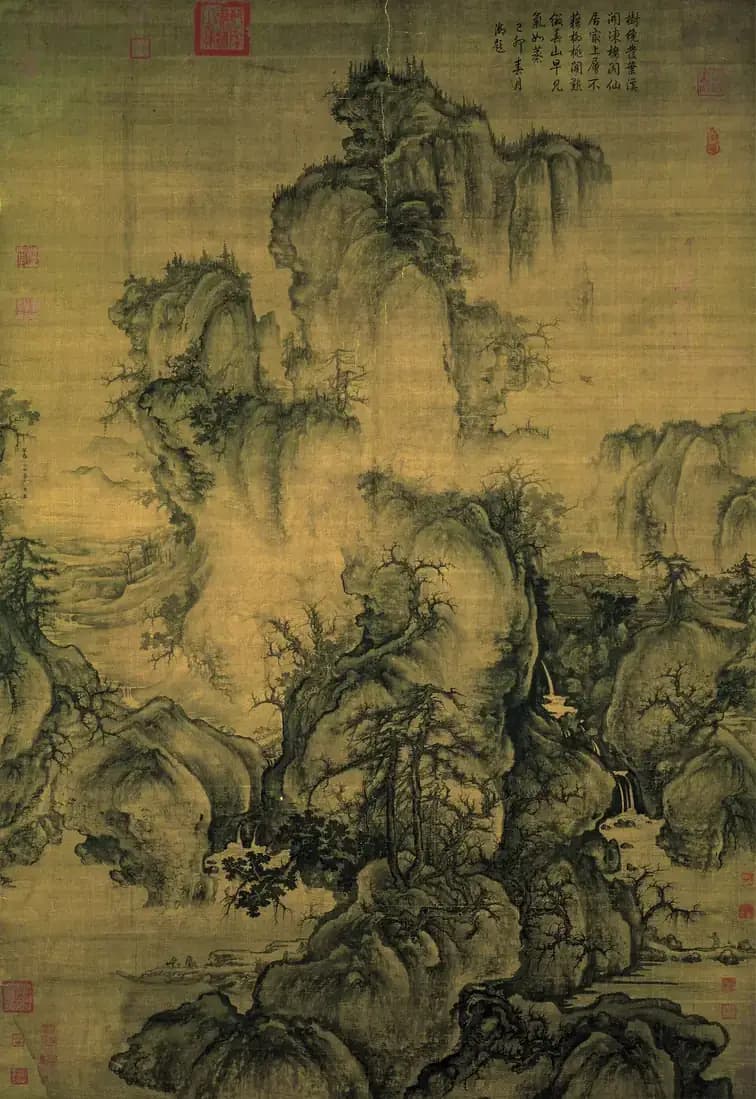
A mountain explored rather than surveyed
The composition does not obey the single viewpoint of a photograph. Guo Xi shifts our position as the eye travels: near rocks are seen from above, the central mountain rises before us, and distant peaks recede into mist. His idea of “three distances” made landscape something the viewer could mentally enter and roam.
Spring begins in water and mist
Colour is restrained, so seasonal change appears through activity. Streams have begun to run, cloud and mist move around the rocks, and trees push fine branches into damp air. Dense ink shapes emerge and disappear, making the mountain seem to breathe rather than stand as a fixed mass.
Find the human scale
Small travellers, buildings and paths are scattered through the enormous terrain. They do not dominate it, yet they make its spaces habitable. Guo Xi painted for the Northern Song court and wrote that a landscape should offer places where one could travel, gaze, wander and dwell. Early Spring turns those possibilities into a single upward journey.
A mountain made for wandering eyes
The hanging scroll cannot be absorbed from one fixed centre. Paths disappear behind rocks, streams turn out of sight and roofs emerge at several heights. Guo Xi described landscape as offering places one might travel, view, wander and dwell. The painting enacts that idea by letting the eye climb gradually rather than presenting the mountain as a single distant silhouette.
Early spring is visible through transition, not through blossoms. Ice loosens, water gathers and mist begins to separate forms that winter had locked together. Dark trees twist against pale vapour, making the mountain seem to wake from within. The scale moves continually between massive and minute: a peak can dominate the scroll, yet one small traveller is enough to turn its paths into imaginable distance.
Sources and further reading
- National Palace Museum digital archiveAuthoritative object record, date, material and dimensions.
- The Metropolitan Museum of Art study of Guo XiGuo Xi's landscape structures and viewing ideas.