The landscape pulls inward
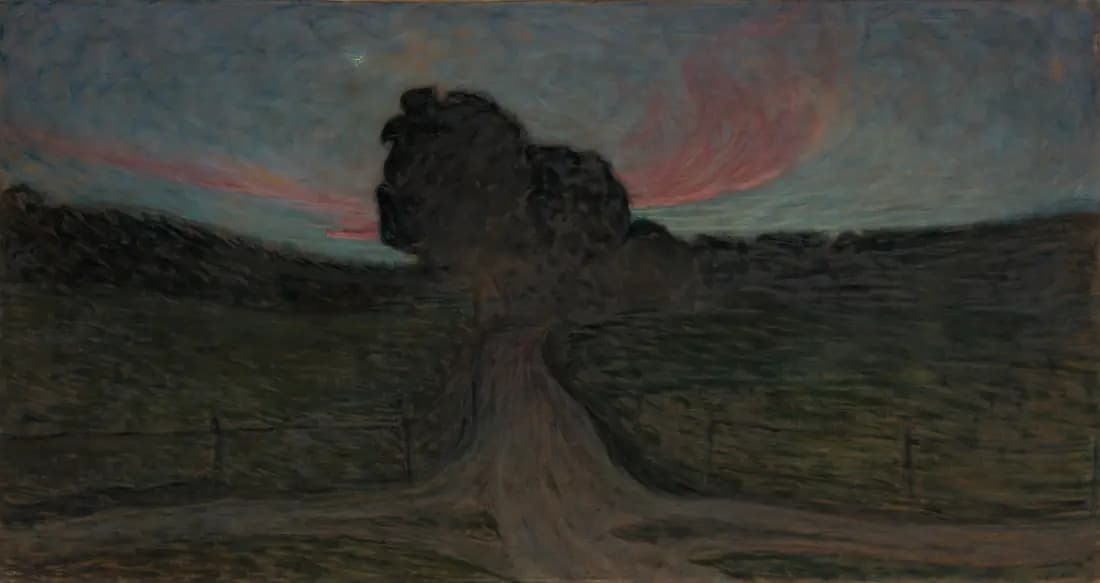
A pale road enters at the bottom, forks, and narrows toward a dense stand of trees. Fence posts and the marks across the fields repeat that movement. Even the long blue and pink strokes in the sky seem to curve toward the dark center.
The Cleveland Museum calls this a telescopic perspective. Space appears compressed, as though distance has been drawn closer without the scene becoming sharply detailed. The central trees act less like one object among many than a weight holding the whole field in place.
One point of light resists the dusk
The sunset survives as a low pink band, partly hidden by the trees. Higher up and slightly left of center, a single pale point interrupts the blue-gray sky. The museum identifies it as the first evening star and describes it as a small relief within an otherwise melancholy view.
That emotional account begins with visible contrasts: tiny light against broad darkness, open sky against a blocked horizon, and a path that approaches the trees but offers no clear passage through them. Jansson does not need figures to make the field feel inhabited by attention.
Brushwork makes evening move
The sky is not a smooth backdrop. Curving strokes carry blue, gray, green, and muted pink across it, while shorter marks roughen the field below. The repeated direction of the paint turns fading light into something active rather than merely dim.
Jansson became known for blue-toned views of Stockholm. Sweden's Nationalmuseum describes his bold dark brushwork and stylized, often unpeopled cityscapes as attempts to convey mood as much as outward appearance. In this field on Lidingö, the same approach makes ordinary ground feel psychologically charged.
A real place becomes an inner landscape
The title locates the scene on Lidingö, near Stockholm, but the painting gives few topographic landmarks. Road, field, trees, sunset, and star have been reduced to a compact structure of approach and obstruction. The place remains specific without becoming a survey.
Cleveland connects Jansson's aim to Symbolism and to his knowledge of Edvard Munch's work. That context helps explain why exact description is not the final goal. The field supplies the materials, while compression, color, and rhythm turn an evening view into an experience of watching daylight disappear.
Sources and further reading
- Cleveland Museum of Art collection recordExact work, date, medium, dimensions, location, telescopic perspective, brushwork, sunset, evening star, and Symbolist context.
- Nationalmuseum, Riddarfjärden in StockholmJansson's blue-period palette, dark brushwork, unpeopled Stockholm views, Munch's influence, and his use of landscape to convey mood.