A vast sky, briefly occupied
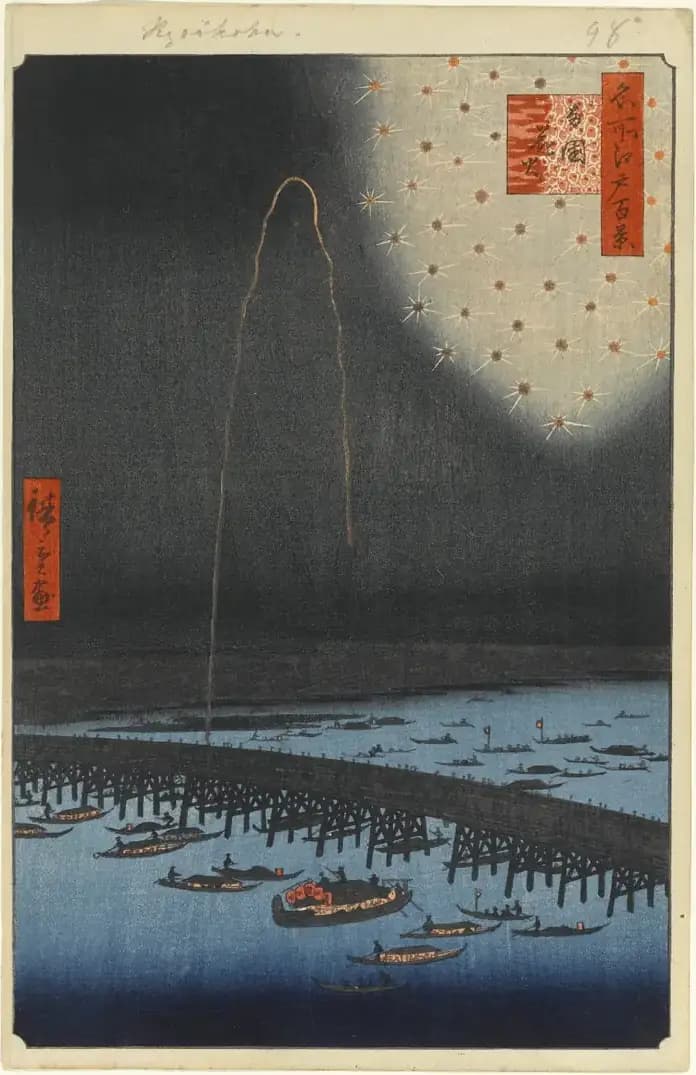
Hiroshige gives more than half the print to darkness. A single firework opens near the top edge, its narrow branches held against graded blue-black ink. Smaller sparks at the horizon suggest other bursts beyond our view. By refusing a crowded display, the print preserves the instant when one explosion reaches its widest shape before disappearing.
The river becomes a theatre
Ryogoku Bridge is packed from end to end, while pleasure boats fill the Sumida below. Some carried food and drink; others offered a moving platform from which to watch. The bridge cuts a strong diagonal across the vertical sheet, separating the dark sky from a restless pattern of roofs, lanterns and reflections.
An Edo summer tradition
Public fireworks at Ryogoku were associated with the opening of the river season, when evening entertainments returned to the Sumida. The custom developed during the eighteenth century and survived in changing forms. Hiroshige records more than spectacle: he shows a city gathering around water, with the distant firework, crowded bridge and close boats all sharing one summer night.
Follow the light from top to bottom
Start at the burst, then let your eye descend. A few sparks lead toward the smaller fireworks on the horizon, then to the bridge lamps and finally to the boats. Hiroshige has distributed light in diminishing scales, from a shape that fills the sky to pinpoints carried by individual people. The darkness between them is not empty. It gives every light enough room to register.
The print also rewards looking sideways. Boats overlap without forming a neat row, and the bridge is less a monument than a dense ribbon of bodies. From a distance the scene reads immediately as celebration. Up close it becomes a collection of separate nights: passengers talking, vendors working and spectators choosing their own view of the same brief event.
Sources and further reading
- The Metropolitan Museum of Art collection searchRelated impressions, series details and object records.
- Library of Congress, Japanese printsInstitutional context for Hiroshige and digitised Japanese woodblock prints.