After the Seine burst its banks
In March 1876, the Seine flooded Port-Marly, a village west of Paris near Sisley’s home at Marly-le-Roi. He returned to the event across a sequence of paintings, observing not only the flood at its height but its changing stages.
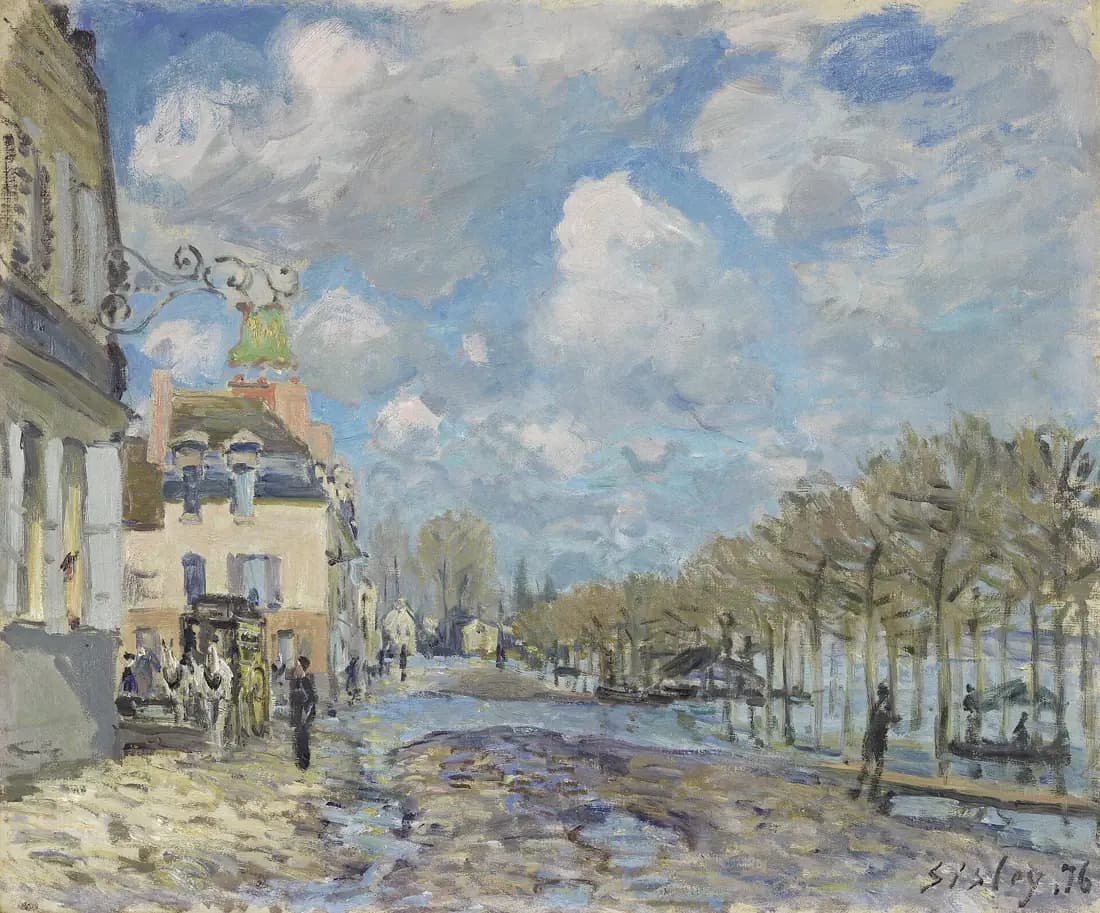
This version comes late in that sequence. Sunlight has returned and the water is falling. Patches of street reappear in the foreground, enough for Sisley to set up with a centred view down the road rather than look across an uninterrupted lagoon.
The sky occupies half the story
The horizon is low. Large clouds travel across an expanse of blue, and their broken whites and greys answer the reflections below. Sisley makes the flood feel inseparable from the weather system that produced it, even as the brighter sky promises release.
At the left, the wine merchant’s sign and the hard edges of the buildings resist the shifting surface. To the right, trees, boats and their reflections break into strokes. Solid architecture and moving water are painted with different kinds of certainty.
Disaster without spectacle
There is no heroic rescue and no towering wave. People stand near the shop; a boat still occupies the flooded street. Sisley treats an extraordinary interruption through the scale of ordinary life. The quietness is not proof that the flood was harmless. It records how quickly daily routines adapt around water.
Seen beside his other Port-Marly flood paintings, the image becomes part of a chronology. Water rises, transforms a familiar village, then recedes. Impressionism’s interest in changing light is also an interest in changing conditions: the same place is never quite the same subject twice.
Sources and further reading
- Museo Nacional Thyssen-BornemiszaThe exact painting, receding-water stage, flood sequence and composition.
- Musée d’Orsay, Boat in the FloodA related canvas and institutional account of Sisley’s Port-Marly motif.
- Musée d’Orsay conservation studyThe 1876 flood, Sisley’s response and the colours of a related work.