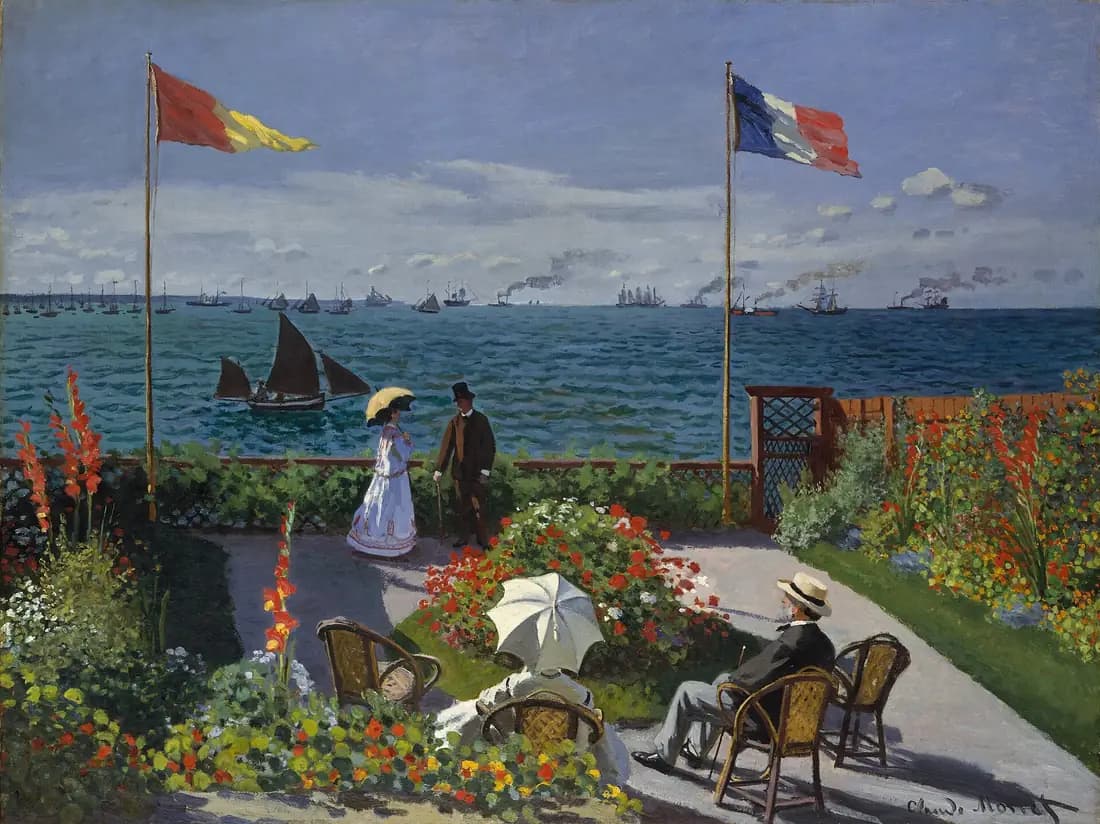
A terrace arranged in bands
The composition stacks flowerbed, promenade, sea and sky instead of leading gradually into depth. A high viewpoint tips the terrace toward us while the horizon runs almost straight across the canvas. The structure has often been connected to Japanese prints, which Monet collected and admired.
Family figures, uncertain identities
Monet stayed near Le Havre with relatives during the summer of 1867. The seated man is usually identified as his father, Adolphe. The other figures may be family members, although not every identification is secure. Their stillness gives scale without turning the painting into a formal portrait.
Leisure beside industry
Sailboats share the sea with steam-powered vessels, and smoke lies along the horizon. The terrace offers bourgeois comfort, but the commercial port is never far away. Monet does not force a conflict between flowers and machinery. Flags, water, smoke and blossoms all become carriers of changing light and wind.
A garden faces a working sea
Bright flowers and seated figures suggest leisure, but the horizon is crowded with steamships and sailing vessels. Monet gives both worlds equal clarity. The garden terrace is not an escape from modern commerce; it is a privileged viewpoint onto it. Flags snap above the flowers while smoke and masts continue the pattern farther out.
The high viewpoint flattens the scene into horizontal bands of garden, water and sky, an arrangement often connected to Monet’s interest in Japanese prints. Within those bands, diagonals from the railing and path hold the space together. The seated pair face away, so the painting does not offer a family portrait’s intimacy. Like them, we are invited to occupy a carefully framed day by the Channel.
Sources and further reading
- The Metropolitan Museum of ArtObject record, figures, location and Japanese print context.
- Musée Marmottan Monet, Claude Monet collectionInstitutional context for Monet's career and serial looking.