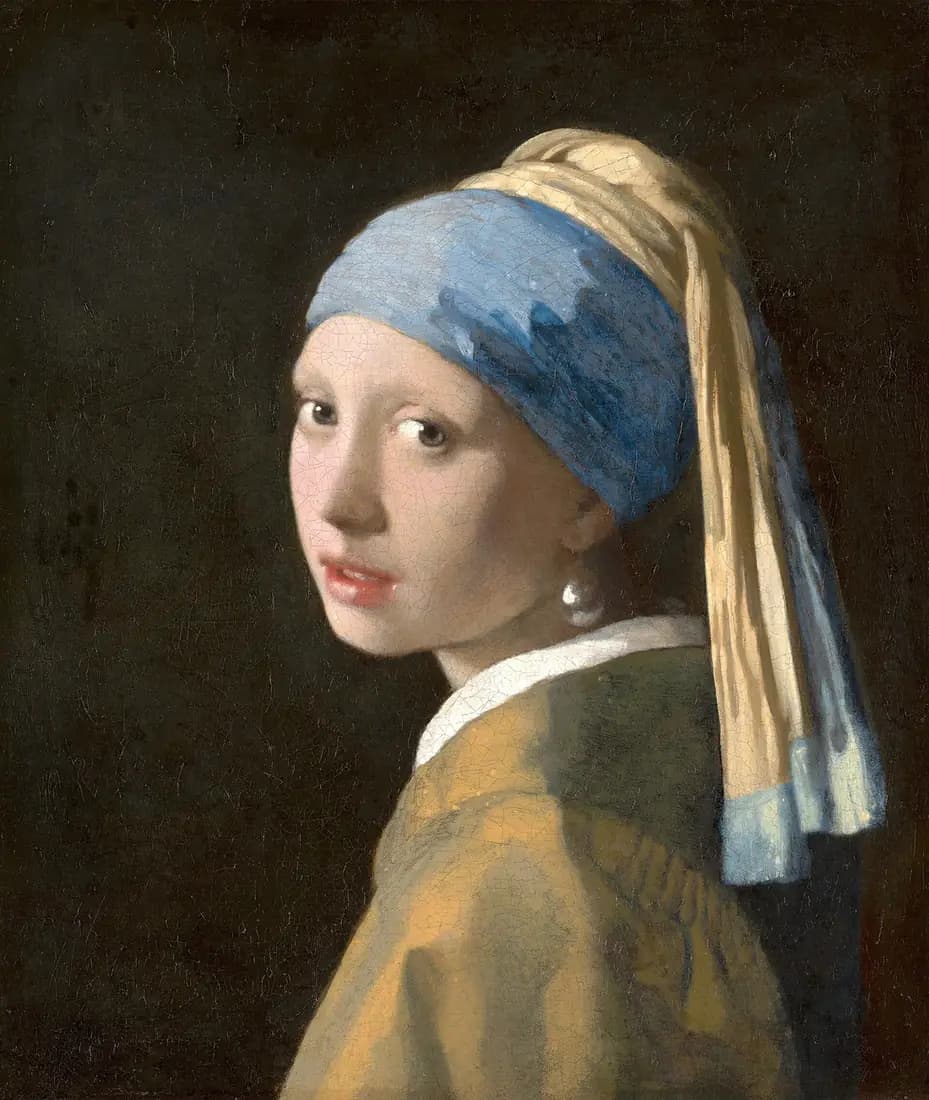
An earring made from light
The lower edge of the pearl is absent. Vermeer places a sharp white highlight near the top and a broader pale reflection below, allowing the viewer to complete the form. No visible hook connects it to the ear. Its unusual size and brilliant surface have even led researchers to question whether it represents a pearl at all.
A face, not a named portrait
Seventeenth-century Dutch viewers called this kind of study a tronie. Such works explored faces, expressions, costume and painterly skill rather than preserving the identity of a client. The exotic headscarf and dark, undefined setting remove the girl from ordinary time and place.
The instant of turning
Her body faces away while her eyes and parted lips return toward us. Vermeer avoids hard contours around the nose and cheek, letting changes of light model the face. Modern technical examination has revealed eyelashes, a green curtain behind the figure and careful pigment choices, but it has not solved who she was. Uncertainty is part of the encounter.
A face assembled from very little
Step close and the famous pearl becomes a few strokes: a bright highlight, a softer reflection below and the dark background showing through around them. There is no carefully drawn hook attaching it to the ear. Vermeer relies on the eye to complete an object whose material may not even be pearl. Illusion arrives through omission as much as detail.
The face works similarly. The turn of the head, parted lips and light along the nose create immediacy, but the dark ground supplies no room, story or social setting. Her exoticised costume marks the picture as a tronie, a study of character and appearance rather than a conventional named portrait. We meet a convincing presence while learning almost nothing about a person.
Sources and further reading
- Mauritshuis collection recordObject history, tronie context and painting details.
- Mauritshuis, Girl in the SpotlightTechnical examination, pigments and discoveries.