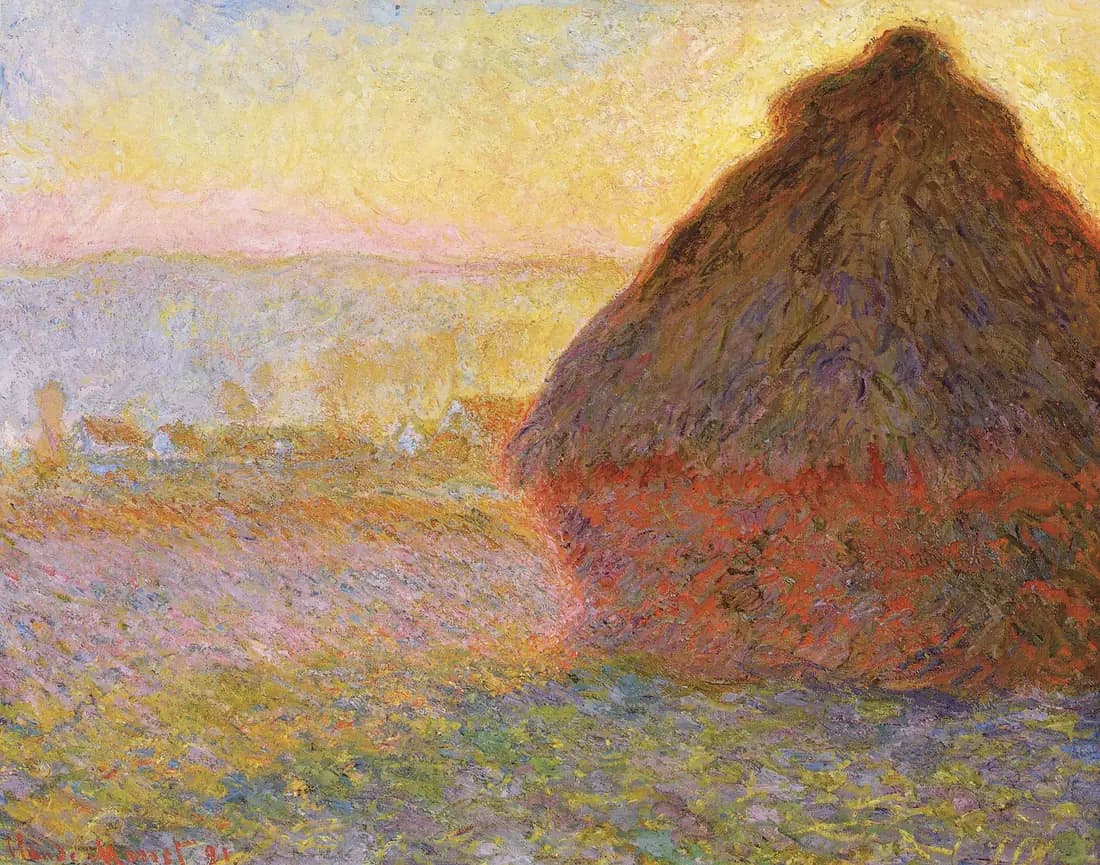
Not a haystack
The forms were stacks of unthreshed grain protected beneath steep roofs of straw. They stood in fields near Monet's house at Giverny and could remain through winter. Their simple mass catches light clearly, while their agricultural purpose anchors the series in an ordinary working landscape.
A fixed subject measures time
Monet worked on several canvases as conditions changed, switching when the effect of light no longer matched the picture before him. The stack keeps roughly the same geometry, but snow, fog, frost and sunset alter its colour, edge and relation to the field. Repetition reveals difference.
An instant completed slowly
The paintings advertise fleeting perception, yet Monet revised them in his studio before exhibiting fifteen together in 1891. That does not make their light less observed. It shows how an impression could be constructed through memory, comparison and layered paint. In this sunset, orange seems to radiate from the stack while violet shadows hold the cold around it.
The object stays while the light changes
Monet returned to the grainstacks because they offered a stable form against unstable conditions. Their blunt silhouettes could hold pink, violet, orange or blue without ceasing to be recognisable. In this sunset, the stack blocks part of the glowing sky and casts a cool shadow, giving colour a physical structure rather than letting it dissolve into atmosphere.
The series was not painted as a mechanical hourly record. Monet worked on several canvases, changed them in the studio and sought an equivalent for remembered sensation. That matters when looking at the apparently spontaneous brushwork. The surface records revision as well as speed. Repetition did not narrow the subject; it revealed how many distinct paintings one ordinary field could sustain.
Sources and further reading
- Museum of Fine Arts Boston, GrainstackCollection records for Monet's grainstack paintings.
- The Metropolitan Museum of Art, Monet series essayMonet's serial practice and changing effects of light.