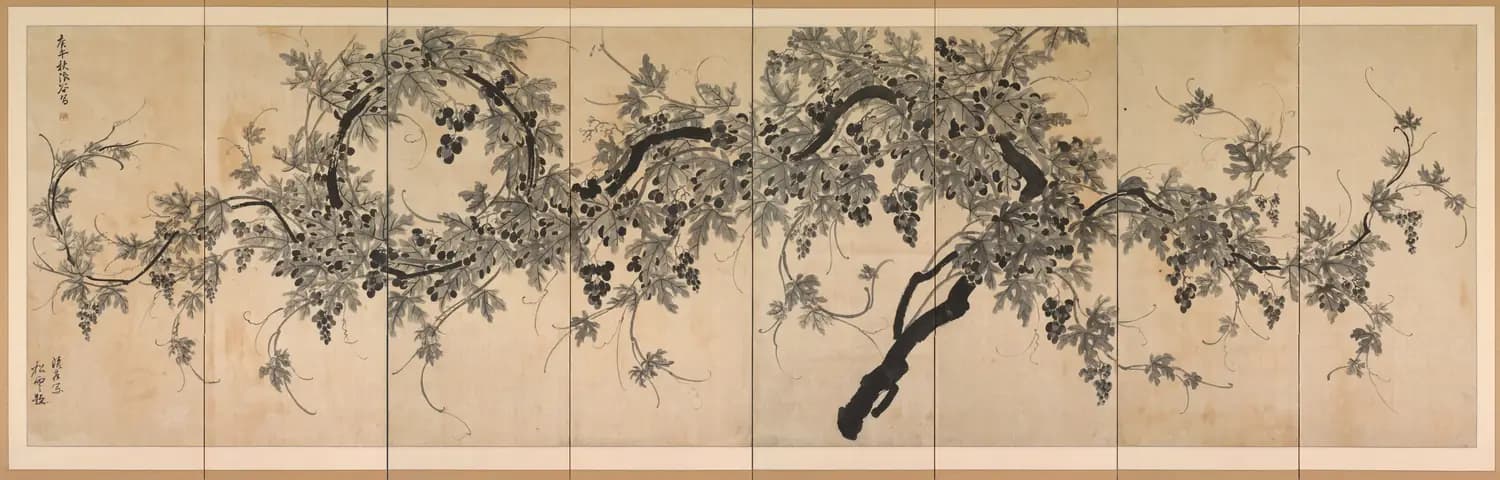
The vine refuses a single panel
A heavy trunk enters low, rises through the middle, and bends back across the screen. Smaller stems divide, loop, and reconnect until the plant seems larger than the eight panels containing it. The folds interrupt the paper, but Choe uses them as a rhythm rather than allowing them to break the image apart.
The sweeping circle gives the composition its force. It can feel like a gust turning vegetation through the air, with grapes and leaves caught at different points in the motion.
Ink makes weather
Choe works without colored pigment. Dense black defines the oldest wood and the deepest clusters; diluted gray lets leaves appear wet, distant, or partly dissolved. Dry and saturated strokes sit beside each other, giving the surface the unstable energy of changing weather.
The Cleveland Museum connects the scene with July, when monsoon rains arrive and grapes ripen. The screen does not illustrate one documented storm, but the brushwork makes season and movement inseparable.
A foreign fruit became a familiar sign
Grapes traveled eastward into China and Korea through the networks now called the Silk Road. Over time the imported vine entered East Asian painting and acquired local meanings. Its many fruits and spreading tendrils could stand for fertility, continuity, and numerous descendants.
That symbolism grows from the plant's visible structure. A single rooted organism produces abundance through branching, curling, and clustering, so the wish is carried by form rather than added as an external code.
A screen changes with the room
Unlike an image fixed flat to a wall, a folding screen can open, close, and angle around a space. Each adjustment changes how the vine crosses the folds and how much of its full arc can be seen at once. The painting therefore has an architectural life as well as a pictorial one.
The Metropolitan Museum notes that nineteenth-century Korean ink paintings of grapes often grew from album leaves into larger hanging scrolls and screens. Choe's work uses that enlarged field to make a botanical subject surround the viewer with motion.
Sources and further reading
- Cleveland Museum of Art collection recordExact screen, artist, format, monsoon imagery, ink handling, Silk Road history, and fertility symbolism.
- Metropolitan Museum of Art, Grapevine and SquirrelsKorean grape painting and the expansion of the subject into larger nineteenth-century formats.