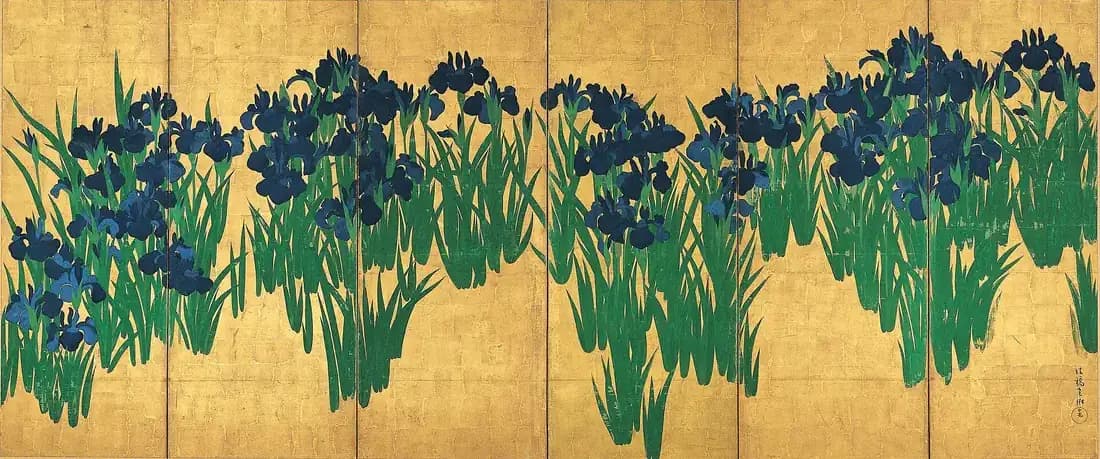
A landscape without a horizon
Gold leaf removes ordinary depth. Irises seem to float across the paired screens, arranged in dense and open groups. Korin repeats and reverses related flower and leaf shapes, using a limited vocabulary to create a rhythm that changes as the folding surface opens.
A poem hidden in the flowers
The subject refers to the Eight Bridges episode of The Tales of Ise. Travellers stop beside a river filled with irises, and one composes a poem whose lines begin with the syllables of kakitsubata, the Japanese word for iris. Viewers familiar with the story could supply bridge, water and travellers from flowers alone.
Repetition as invention
Close comparison reveals that many blossoms derive from stencils or repeated patterns rather than separate botanical portraits. That economy is the design's strength. Small variations in overlap, direction and interval make the plants feel musical, while blue and green gain unusual intensity against the reflective gold ground.
Repetition without a horizon
The screens offer no sky, soil line or distant garden. Irises occupy a gold field in clustered intervals, leaving broad emptiness between groups. Their leaves repeat a limited set of strong diagonals, while blue flowers provide irregular accents. The eye supplies continuity across gaps that a descriptive landscape might have filled.
Korin is often connected with the iris episode in The Tales of Ise, where a traveller composes a poem using the syllables of the flower’s Japanese name. The literary association enriches the screens but does not need to be decoded to enjoy them. Their achievement is physical and rhythmic: mineral colour, repeated forms and folding surfaces turn a familiar plant into an environment that changes as the viewer moves.
Sources and further reading
- Nezu Museum, National Treasure IrisesObject, screens, materials and Tales of Ise subject.
- The Metropolitan Museum of Art, Rinpa artKorin, Rinpa design, repetition and literary themes.