Two attractions in one view
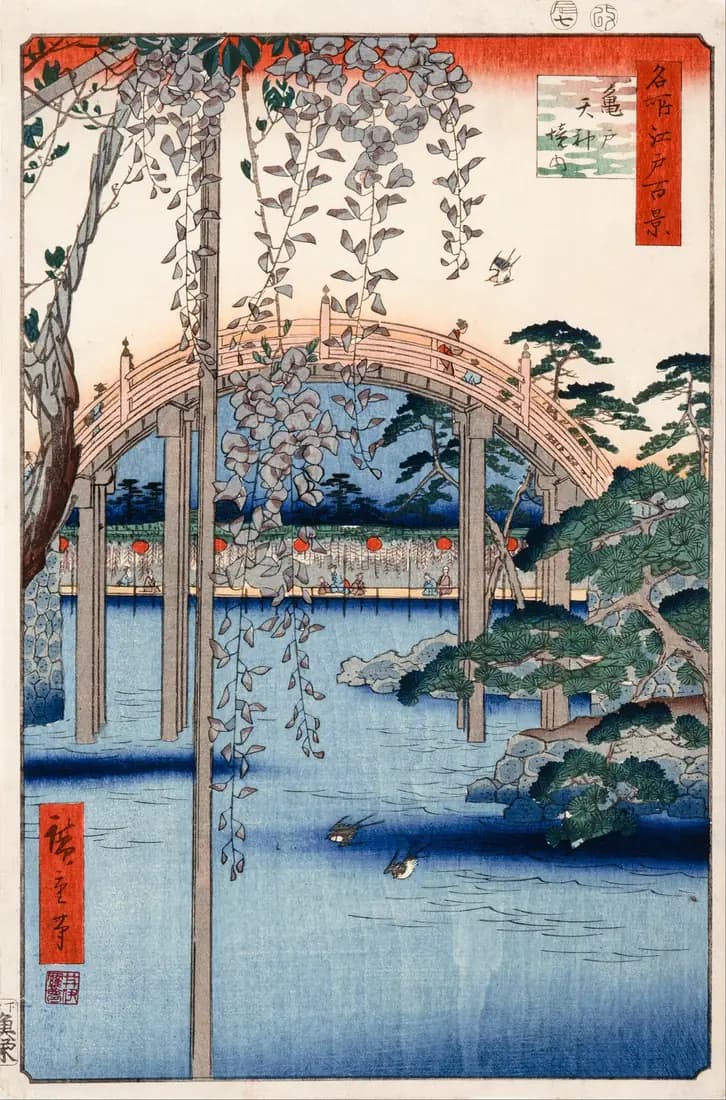
Kameido Tenjin Shrine was known for wisteria trellises and arched drum bridges. Hiroshige combines them by bringing one close and keeping the other distant. The flowers create an irregular purple border while the bridge supplies a bold, nearly geometric curve beyond.
A bridge made steeper by design
The arch looks dramatically high in the print, and the narrow vertical format makes the climb more extreme. Visitors appear at different points on the slope, turning its curve into a sequence of small efforts. Three birds cross the open sky above, balancing the dense flowers below.
A composition travelling west
Japanese prints circulated widely in nineteenth-century Europe. Van Gogh owned examples and made a painted copy of this design, adding intense colour and a decorative character-filled border. His version is an act of study as much as admiration. It demonstrates how Hiroshige's crop, scale and flat colour offered European painters a different way to organise space.
A bridge seen through hanging flowers
The wisteria does not decorate the edge politely. Heavy clusters descend across the view, leaving only fragments of the arched bridge and garden beyond. Their closeness makes the flowers almost tactile, while the small people on the bridge establish a very different scale. Hiroshige asks us to look through abundance rather than stand back from it.
The bridge’s steep curve was exaggerated, but the distortion clarifies the experience of crossing. Figures climb, briefly reach the top and descend out of sight, a sequence visible at once in the print. Water below repeats the arch more quietly. Van Gogh’s later copy intensifies outline and colour, yet the original already depends on a bold modern idea: let the frame cut objects before perspective makes them orderly.
Sources and further reading
- British Museum collection recordObject, series and site details.
- The Met, Hiroshige and landscape printsMuseum context for Hiroshige's landscape printmaking.