Darkness gives the windmill weight
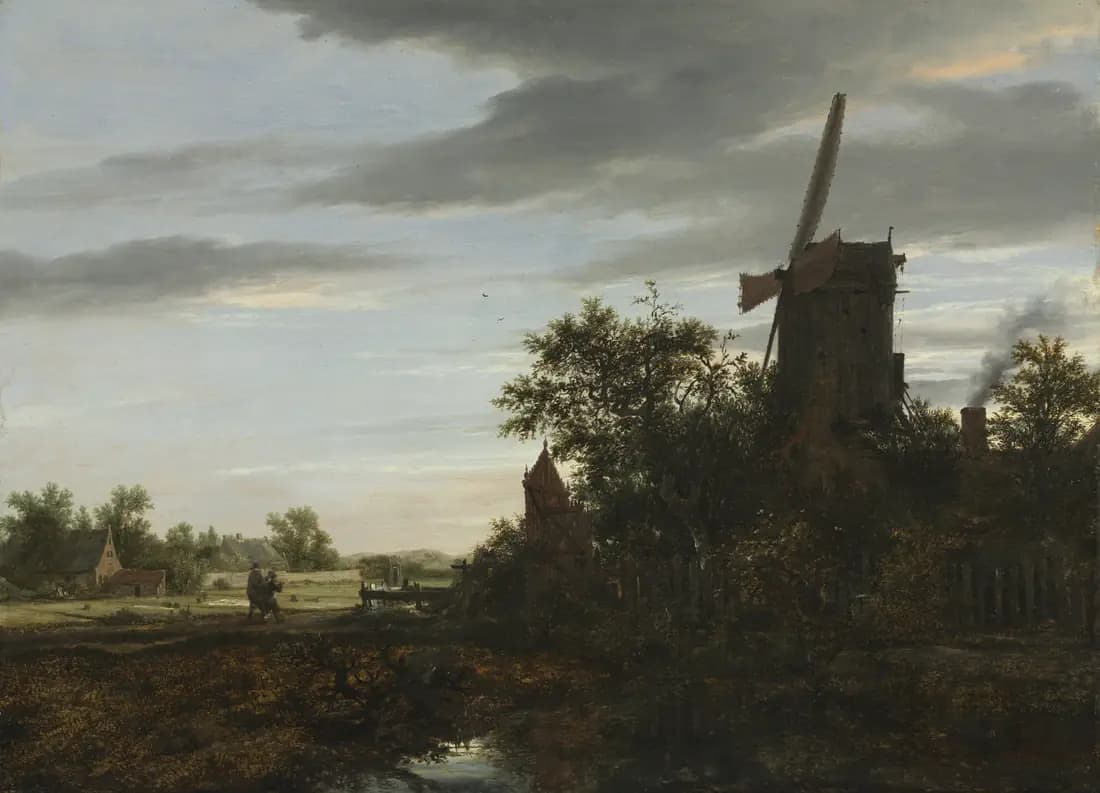
The windmill does not stand alone against a clear sky. Trees, roofs, and shadow gather around its base until building and vegetation form a single irregular silhouette. One sail rises into the clouds, giving the structure a height that the low horizon intensifies.
A muddy road and small pool hold the foreground. Their broken surfaces slow the eye before it can reach the light at left. Ruisdael makes distance feel earned rather than instantly available.
A plain opens beside the shadow
The painting's strongest contrast is not between earth and sky, but between the massed right side and the sunlit plain beyond it. A few people and buildings remain small enough to measure the space without interrupting its calm.
A Getty study of this exact painting calls its construction unusually tight and dramatic. It notes how cottage, trees, gate, and fence gather into a dense right-hand mass dominated by the windmill. Ordinary forms become a structure rather than generic scenery.
White marks contain months
Look across from the windmill and pale lengths appear in the field. The Cleveland Museum identifies them as linens bleaching naturally in sunlight, a process that could take several months. What resembles a quick glint is evidence of repeated handling, weather, and time.
That detail changes the landscape's quiet. The distant plain is not unused land. Work occurs at a scale too small to dominate the picture, embedded in the same cycles of moisture, sun, and air that shape the clouds above it.
An early painting already thinks grandly
Ruisdael painted this work while still a teenager. The museum emphasizes how he could make simple motifs appear heroic. Monumentality here comes from arrangement, not from choosing a celebrated building or dramatic mountain.
The mill remains local and useful, its surrounding fields marked by labor. Yet the dark silhouette, sudden light, and layered weather lift it into a larger meditation on duration. A structure built to harness wind stands beneath a sky whose movement no building can control.
Sources and further reading
- Cleveland Museum of Art collection recordExact work, date, medium, youthful artist, light and shadow, and linen bleaching.
- Getty Publications, Jacob van Ruisdael: Windmills and Water MillsExact Cleveland painting, its 1646 date, tight composition, dramatic massing, clouds, and windmill context.