A royal portrait from the edge
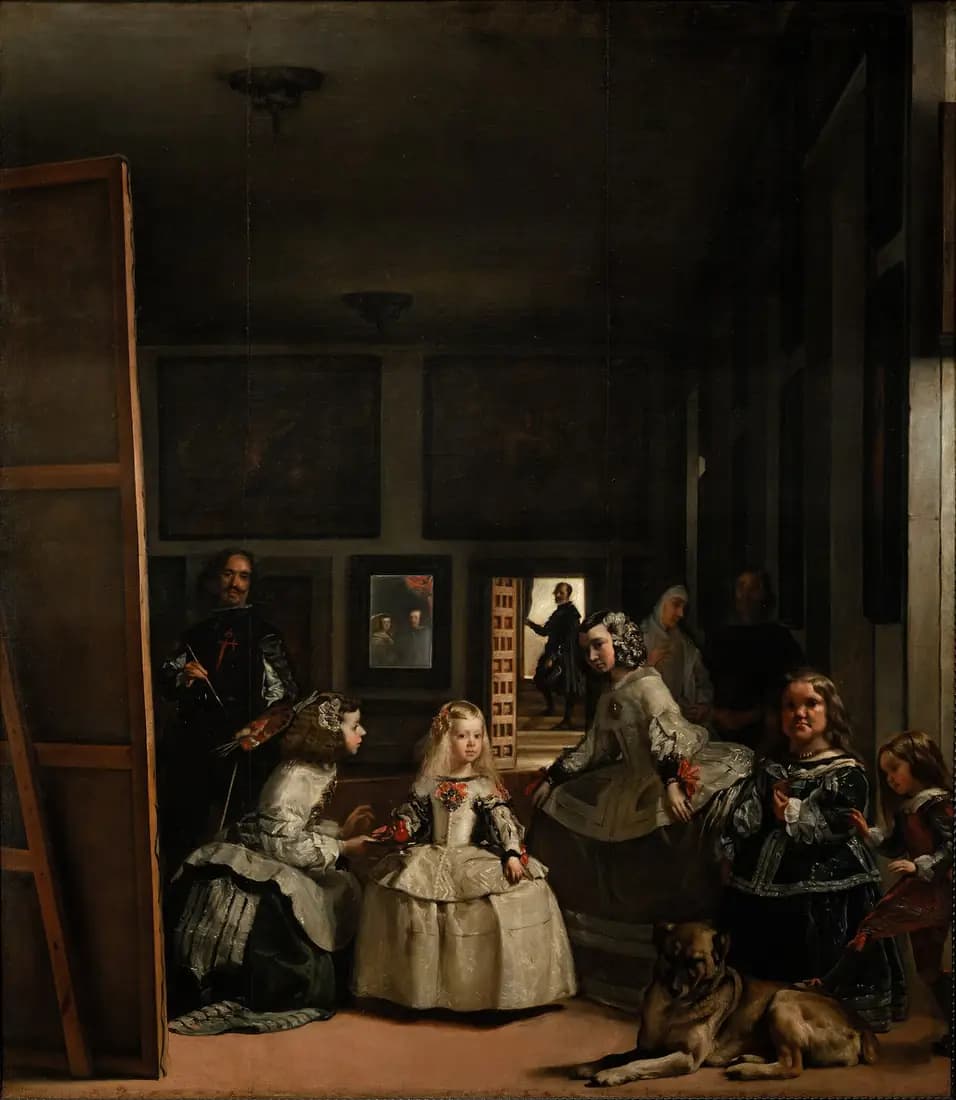
The five-year-old Infanta Margarita stands among attendants, a chaperone, a guard, two court dwarfs and a mastiff. Velázquez places himself at the left before a canvas whose front we cannot see. Instead of presenting royalty in a fixed ceremonial arrangement, he gives us a room interrupted by an arrival or a glance.
Who occupies our space?
In the mirror on the far wall, King Philip IV and Queen Mariana appear as small luminous reflections. They may be posing for the canvas Velázquez paints, entering the room, or reflected from another image. Each answer changes the viewer's position. The painting is famous partly because it makes that uncertainty structural rather than accidental.
A room built from attention
The open doorway, mirror, framed pictures and hidden canvas create images inside the image. Yet the space remains immediate: the dog rests, one attendant offers a cup and another begins a curtsy. Velázquez combines loose, economical paint with rigorous perspective, allowing ordinary gestures and royal representation to occupy the same unsettled instant.
Every glance changes the room
The infanta looks outward, one attendant bends toward her, another faces away, a dog rests below and a courtier pauses in the doorway. Velázquez gives each figure a different relation to whatever stands before the canvas. Those crossed lines of attention make the room feel larger than its architecture because part of the event must be taking place where the viewer stands.
The mirror deepens that uncertainty. It reflects the king and queen, but scholars continue to debate whether they are physically present, reflected from the large canvas or represented through another optical arrangement. The puzzle matters less as a trick with one solution than as a structure. Painter, royal family, attendants and spectator all depend on who is looking at whom.
Sources and further reading
- Museo Nacional del Prado collection entryFigures, setting, title and interpretation.
- Museo del Prado, Las Meninas multimediaInstitutional close-looking and composition context.