One curve drives the scroll
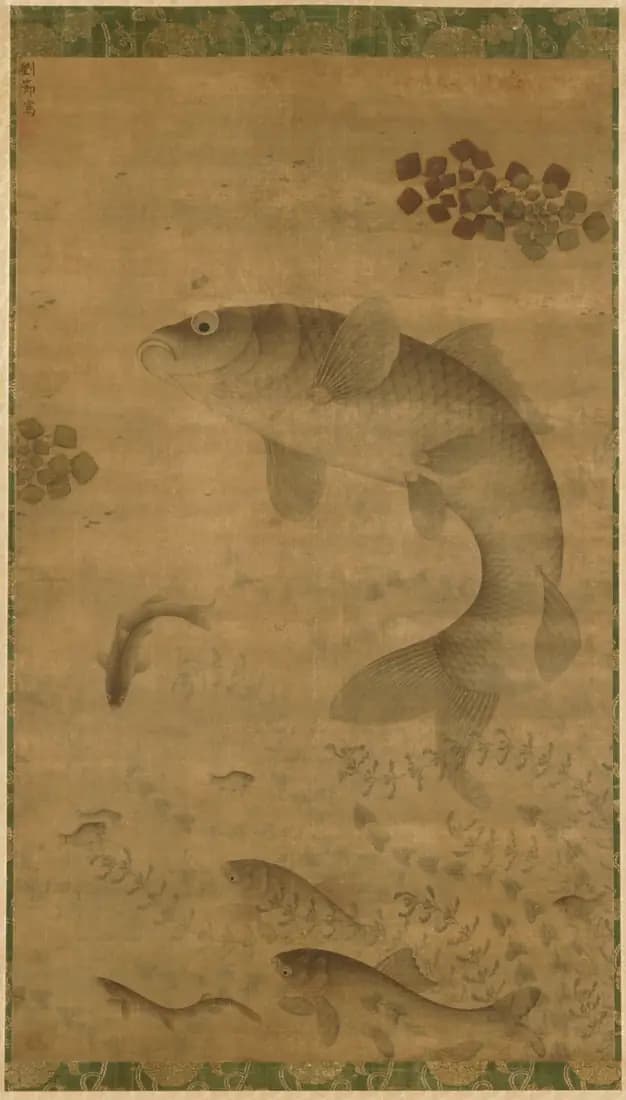
The largest carp rises through the center and bends so sharply that its head and tail point in different directions. A round eye, parted mouth, spread fins, and overlapping scales make its body feel both heavy and suddenly mobile. The tall format gives that turn room to climb.
Several smaller fish remain below, dispersed among fine water plants. Clusters of dark, angular leaves near the edges, probably water caltrap according to the museum, mark the watery setting without enclosing it. Much of the silk remains open, so the fish seem to move through depth rather than across a crowded pattern.
Fine lines meet graded wash
Liu Jie builds the carp with two kinds of attention. Precise lines separate scales and fin rays, while graded ink wash rounds the body and lets its far side recede. The paler smaller fish appear farther away, even though the water itself has no firm horizon.
The Cleveland Museum identifies Liu Jie as a Ming court painter known for fish. His signature and seal sit at the upper left, small beside the animal that dominates the surface. Technical control serves movement: repeated arcs in the body, fins, and plants guide the eye up and back down.
A leap can become a transformation
One museum-supported reading connects the image with the legend of a carp that leaps the Dragon Gate and becomes a dragon. In art, that difficult passage could stand for a scholar succeeding in the civil service examinations. The Metropolitan Museum documents the same association in Chinese objects pairing carp, transformation, and official advancement.
This meaning is a cultural association, not a literal event shown in every detail. No dragon appears here and no gate is visible. What the painting supplies is the decisive upward bend of a carp, an image well suited to a story about persistence and change.
The second reading changes the group
Cleveland also records another interpretation: the large carp may be guiding its offspring in worshipping heaven rather than leaping alone. Under that reading, the smaller fish are not background witnesses to individual achievement. They form a family group led by the largest body.
The two accounts direct attention differently, one toward upward transformation and the other toward the relationship between fish. The Cincinnati Art Museum has emphasized that Chinese animal painting developed a complex symbolic language rather than a single fixed code. Liu Jie's scroll rewards that caution: its visible action is vivid, while its story remains open.
Sources and further reading
- Cleveland Museum of Art collection recordExact scroll, dynasty, medium, dimensions, signature, seal, water caltrap, technique, and the two documented interpretations.
- Cincinnati Art Museum, Roaring Tigers, Leaping CarpInstitutional context for the evolving and complex symbolic language of animals in Chinese painting.
- Metropolitan Museum of Art, Vase with the Pole Star deityThe carp, Dragon Gate transformation, and civil service examination association in Chinese visual culture.