Mist divides the climb
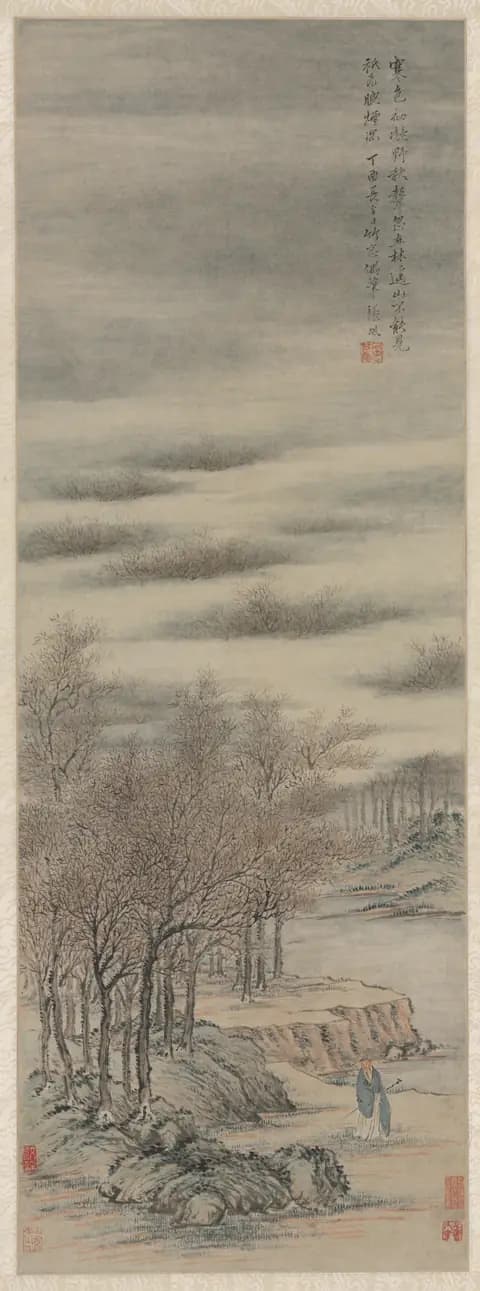
Dense rocks and trees gather near the lower part of the scroll. Above them, pale horizontal bands interrupt the landscape before distant forms reappear. Mist is not simply empty background. It establishes intervals, allowing the eye to climb through alternating passages of brushwork and open paper.
A small figure with a staff moves across the lower grove. His scale turns nearby trunks into a forest and makes the vertical journey feel longer than the sheet's narrow width might suggest.
The title asks the eye to listen
Nothing painted can literally make a sound, yet the title directs attention toward rustling leaves, steps, and wind among branches. The sparse figure appears to pause within that sensory world rather than conquer it. Looking becomes an act of imagining what lies beyond sight.
The Met describes Zhang's related landscapes as exploring the exchange between visual and poetic imagery, including murmuring pines and running water. Sound was part of how his painted places could be understood.
Red survives beneath the gray
Close inspection reveals red strokes in the ground. Cleveland connects them to Zhang's loyalty to the fallen Ming dynasty because the ruling family's name, Zhu, means red. The sign is deliberately restrained: political memory does not arrive as a banner but persists inside the earth.
That detail changes the subdued palette. Ink, frost, and mist may first look almost colorless, yet the small red marks make color carry historical allegiance.
Reclusion followed a change of dynasty
Zhang passed local examinations shortly before the Ming collapsed in 1644. He refused to serve the new Qing government and lived at times as a Buddhist practitioner. The Met's dated album from 1644 and later Stone Bridge both connect solitary landscapes to this loyalist withdrawal.
The traveler in the mist need not be treated as a literal self-portrait. He can still embody the problem that shaped Zhang's art: how to continue moving through a transformed world while keeping faith with what has been lost.
Sources and further reading
- Cleveland Museum of Art collection recordExact object, figure, mist, loyalist biography, Buddhist life, and red ground strokes.
- Metropolitan Museum of Art, Landscapes by Zhang FengZhang's response to the Ming collapse and the interplay of poetic, visual, and sonic imagery.