A title borrowed, not illustrated
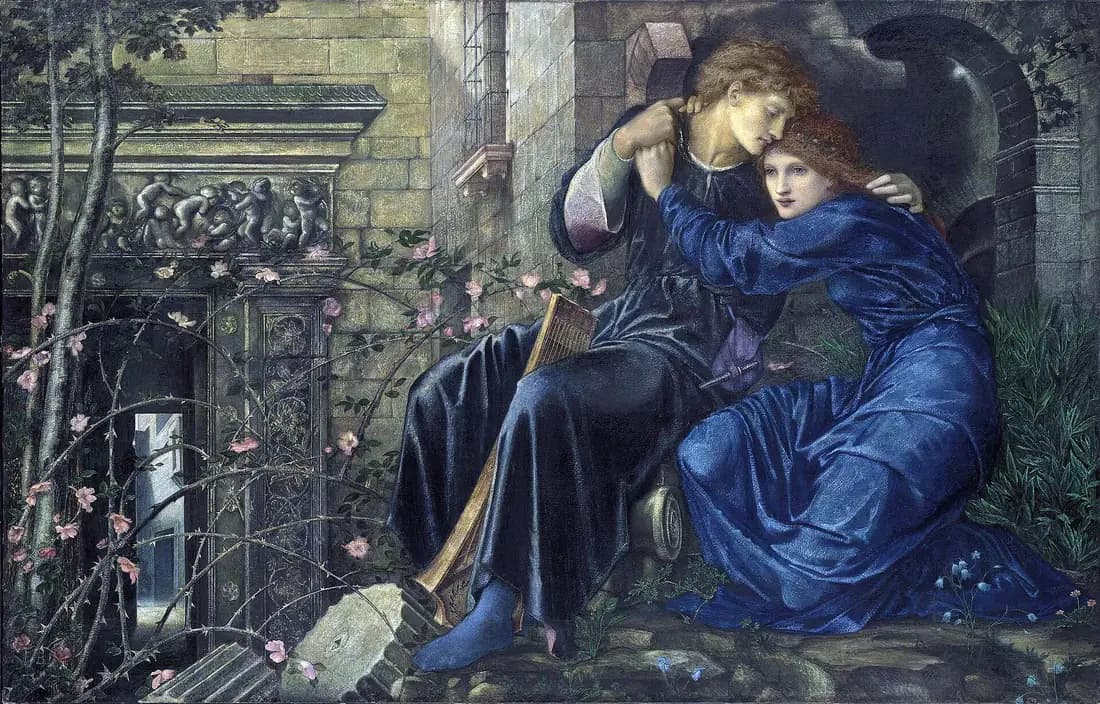
Robert Browning's poem Love Among the Ruins contrasts vanished power with a present meeting of lovers. Burne-Jones takes its emotional premise rather than narrating each line. No recognisable ancient city appears. Architecture, vegetation and figures belong to a suspended world assembled for mood.
Blue holds the scene together
Stone, sky and shadow share deep blue and violet, while the lovers' skin and cloth bring muted warmth to the centre. Repeated verticals of columns and stems make the embrace feel enclosed. The ruin is open to weather, but visually it behaves like a private room.
A fragile surface with a dramatic history
The 1873 work was made in watercolour and bodycolour, allowing a luminous matte surface. It was badly damaged while being photographed in the twentieth century and painstakingly restored. Burne-Jones later returned to the composition in oil, evidence that the arrangement of lovers, briars and architecture remained important to him.
Ruins become an emotional climate
Burne-Jones places the embracing pair low among briars, broken masonry and faded blue architecture. The setting does not illustrate one named ruin. It turns loss into an environment that surrounds the figures without separating them. Their bodies form a quiet vertical at the centre while vines and damaged walls continue outward.
The work’s own physical history unexpectedly echoes its subject. The original watercolour was damaged in the twentieth century and underwent difficult restoration, while an oil version preserves Burne-Jones’s return to the composition. That accident should not be forced into an allegory, but it changes how the fragile surface is seen. An image about affection surviving among remnants has itself survived damage, repair and translation into another medium.
Sources and further reading
- The National Trust, Love Among the RuinsOil replica and a detailed history of the damaged 1873 watercolour.
- The Met, Edward Burne-Jones collection searchMuseum collection context for Burne-Jones and his work.