A close object changes the whole landscape
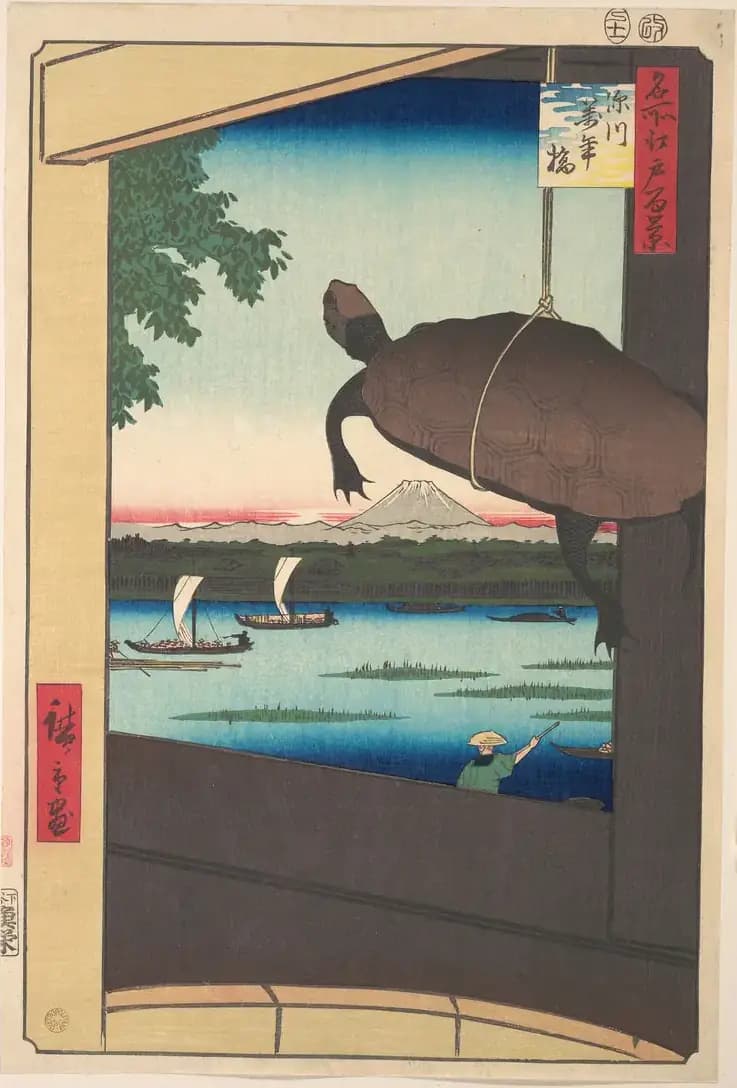
The underside of Mannen Bridge becomes a dark frame. Rope, railing and the hanging turtle cut across the sky while river and shore extend below. Hiroshige's radical scale makes the turtle impossible to treat as a small anecdote; it becomes the gateway through which the city is seen.
A creature waiting for release
Vendors near bridges and temples sold turtles so buyers could release them, a practice associated with compassion and religious merit. The cord made the animal visible and retrievable before purchase. That context gives the suspended pose a meaning different from a captured food animal, although the modern viewer may still feel its discomfort.
Fuji at the limit of vision
Mount Fuji is tiny on the horizon but aligned so precisely that it holds its own against the shell. Boats and warehouses describe Edo's working waterways between the two. The composition compresses several scales of existence: one animal close enough to touch, a city in motion and a mountain far beyond both.
A turtle interrupts Mount Fuji
A turtle hangs for sale from the bridge railing, so close that it nearly fills the upper half of the sheet. Beyond it, boats pass and Mount Fuji rises small on the horizon. The startling change of scale is comic at first, then precise. An ordinary market object and a national landmark occupy the same line of sight without becoming equivalent.
The turtle may have been intended for ceremonial release, a Buddhist act of merit in which captive animals were set free. Whether a specific buyer will release this one remains unknown, but the possibility gives the cord and open water extra tension. Hiroshige does not narrate the outcome. He constructs a suspended moment in which commerce, compassion, city traffic and distant mountain meet.
Sources and further reading
- The Metropolitan Museum of ArtObject record, turtle-release custom and composition.
- Brooklyn Museum collection searchRelated impression and One Hundred Famous Views context.