Almost nothing happens
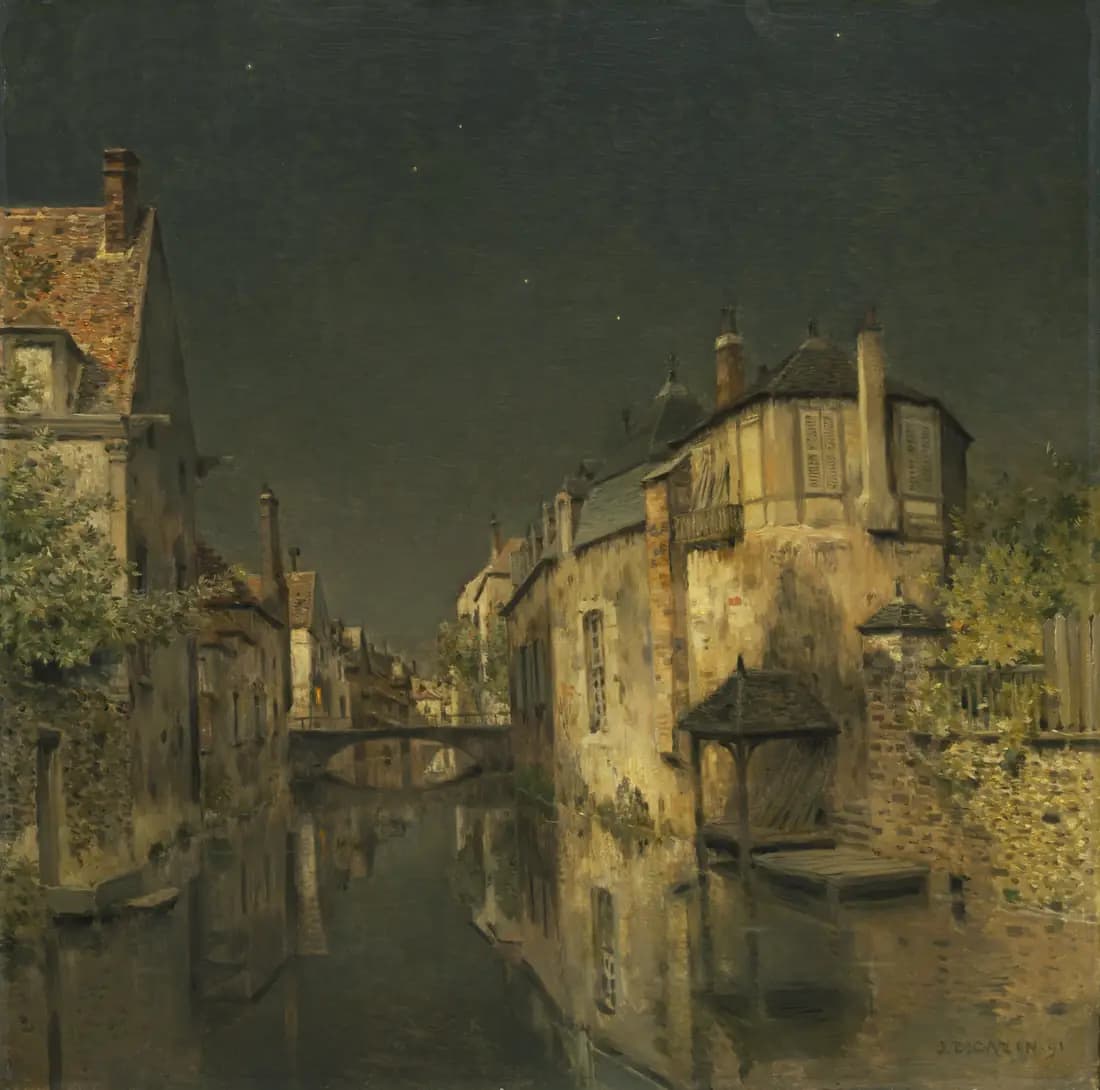
A canal enters at the bottom edge and leads toward a low stone bridge. Buildings on the right catch weak yellow-gray light, while the left bank becomes foliage and shadow. Five faint stars occupy the sky. No lamp blazes, no moon commands the scene, and no figure gives us a story to follow.
That lack of action is the painting's subject. Cazin keeps enough architecture visible to make a real town recognizable, then removes the ordinary noise of streets and water. Stillness begins to feel strange because it is so complete.
The water makes a second town
The canal reflects the pale walls but does not copy them cleanly. Their vertical shapes break and lengthen in the dark surface, while the bridge becomes a narrow boundary between near water and distant space. Much of the lower canvas is therefore architecture transformed into wavering color.
Cazin's almost square format prevents the canal from racing too quickly toward the horizon. Sky and reflection balance one another above and below a middle band of roofs, trees, and stone. The composition holds the viewer in place even as the water offers a route inward.
Abbeville remembered in a studio
The Cleveland Museum identifies the town as Abbeville in northern France, not far from Boulogne-sur-Mer, where Cazin grew up and later painted the surrounding coast and countryside. He knew this region closely, but the finished canvas was not simply a report made at midnight beside the canal.
Cazin preferred studio painting based on memory, a method he had learned at the École Gratuite de Dessin in Paris and later taught to others. Remembering forced the artist to retain relationships and atmosphere rather than copy every small detail. Here that process may help explain why the scene feels specific and simplified at once.
A night that travelled
Midnight was shown at the Paris Salon in 1891. Two years later it appeared at the World's Columbian Exposition in Chicago under a longer title that named moonlight and Abbeville. The painting's early exhibition history helps explain how a quiet French canal entered an American collection and eventually the Cleveland Museum.
The museum describes its atmosphere as almost surreal, though the picture predates Surrealism as a movement. That useful comparison concerns the experience, not a label: familiar houses, water, and stars remain fully legible, yet their silence makes the place feel as if waking life has briefly paused.
Sources and further reading
- Cleveland Museum of Art collection recordExact object, Abbeville setting, memory method, atmosphere, training, and exhibition history.
- Musée d'Orsay artist recordCazin's identity, dates, roles as landscape painter and ceramicist, training, and activity.
- Musée d'Orsay, works by Jean-Charles CazinInstitutional collection context for Cazin's landscapes, drawings, and decorative work.