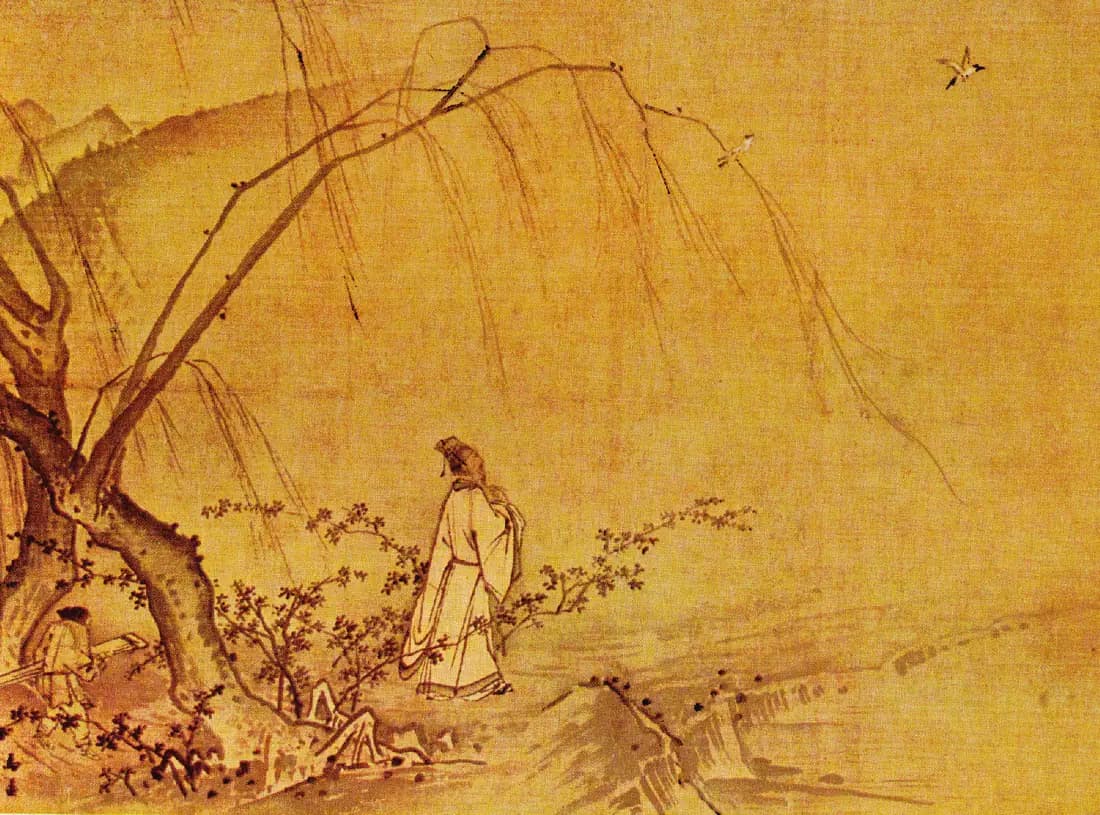
A world pressed toward one corner
Ma Yuan became famous for compositions that concentrate weight at an edge or corner. Here the rocky bank, willow and walkers hold one side while open silk extends around them. The blank area is not unfinished. It supplies atmosphere and gives every bent branch, bird and footstep more room to register.
A pause on the path
The scholar does not stride through the scene. He turns toward the water, sleeve lifted, while a servant follows with a wrapped qin. Small birds skim or rise above the emptiness. Their movement gives the quiet a before and after: something has just happened, although the painting never tells us exactly what.
Spring through a few signs
Willow shoots, new grasses and damp haze establish the season with restraint. A poetic couplet inscribed by Emperor Ningzong describes wild flowers dancing and birds crying as people approach. Image and poem do not illustrate one another mechanically. Together they make spring a response passing between walkers, plants and animals.
The empty space is part of the journey
Much of the silk is left unpainted. That open ground can read as mist, air and inaccessible distance, allowing a very small image to imply a world beyond its edges. The traveller does not cross a fully described setting. He emerges beside rock and willow, while the blankness around him makes the next stretch of path uncertain.
Ma Yuan was celebrated for asymmetrical compositions in which weight gathers in one corner. Here that concentration makes every small gesture count: the servant follows, the scholar turns his head, branches extend into space and birds answer the movement overhead. The poem traditionally associated with the image links the spring breeze to flowers brushing the traveller’s clothes. Painting and verse both make a passing sensation carry the scene.
Sources and further reading
- National Palace Museum collection entryObject details, dimensions, materials, inscription and rights.
- The Metropolitan Museum of Art, Chinese painting essaysSouthern Song landscape, court painting and the role of empty space.