Three reactions meet at one point
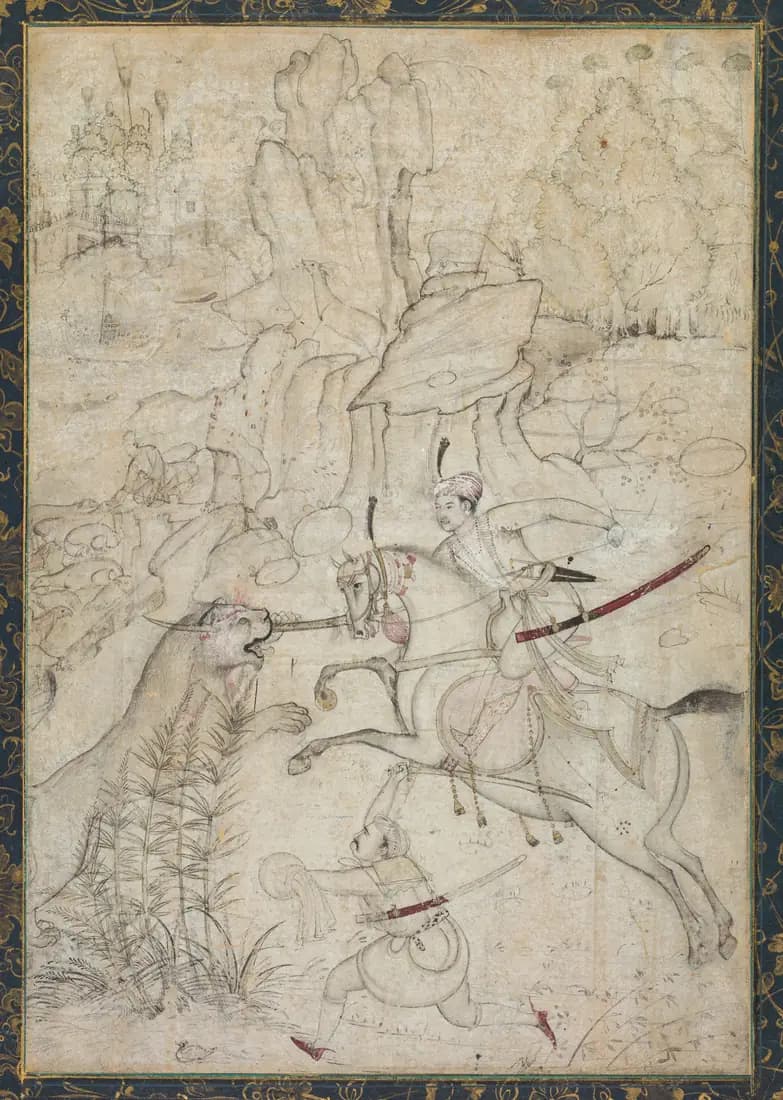
The lion rises from the left with its mouth open. The white horse drives toward it, one foreleg bent inward, while the mounted prince delivers the blow. Their faces crowd around the horizontal weapon, making the encounter feel tighter than the broad rocky landscape around them.
Below, an attendant advances with sword and shield, his head thrown back and his features strained. The Cleveland Museum contrasts his anxiety with the prince's calm. Expression turns hierarchy into something visible: the ruler appears controlled because another figure shows the fear he does not.
The horse shares the courage
The horse is not a neutral platform. It lunges, stares toward the lion, and braces its lifted leg against the force of the attack. Cleveland draws special attention to this response, which makes courage belong to the trained animal as well as the rider.
Small accents of red and gold sharpen the pale sheet: harness, scabbard, clothing, and the flowered dark border. Within the picture, red accents cluster around the prince, while fine lines lead outward through rocks, trees, animals, and distant architecture.
A hunt represents rule
The museum describes the lion hunt as an ancient display of royal courage and power in Iran and the Near East, regions to which the Mughals traced important cultural roots. It also notes that the prince's feat recalls heroes of Persian epic. The subject turns physical danger into an argument about fitness to rule.
Far in the background, a shepherd tends sheep in apparent safety. Cleveland interprets this quiet detail as a contrast produced by the prince's bravery: danger is confronted at the center so ordinary life can continue at a distance. That is a courtly claim, carefully constructed by the image rather than a neutral report of governance.
The page keeps evidence of revision
Areas of white surround several key figures and interrupt the otherwise continuous ground. According to Cleveland, these passages show the artist working out their ideal positions. The page may therefore have served as a study for a more fully colored composition, though that purpose is not certain.
Those revisions let process sit beside performance. The prince appears perfectly composed, while the surface around him records adjustment and reconsideration. A scene designed to make power look effortless survives in an object that shows how much visual work the effect required.
Sources and further reading
- Cleveland Museum of Art collection recordExact page, date, medium, dimensions, horse and figures, Persian epic association, kingship context, shepherd, white revisions, and possible study function.
- Cleveland Museum of Art, Art and Stories from Mughal IndiaInstitutional context for the Mughal painting collection and the exhibition in which this work appeared, including its relationship to epic and courtly storytelling.