A subject remembered across decades
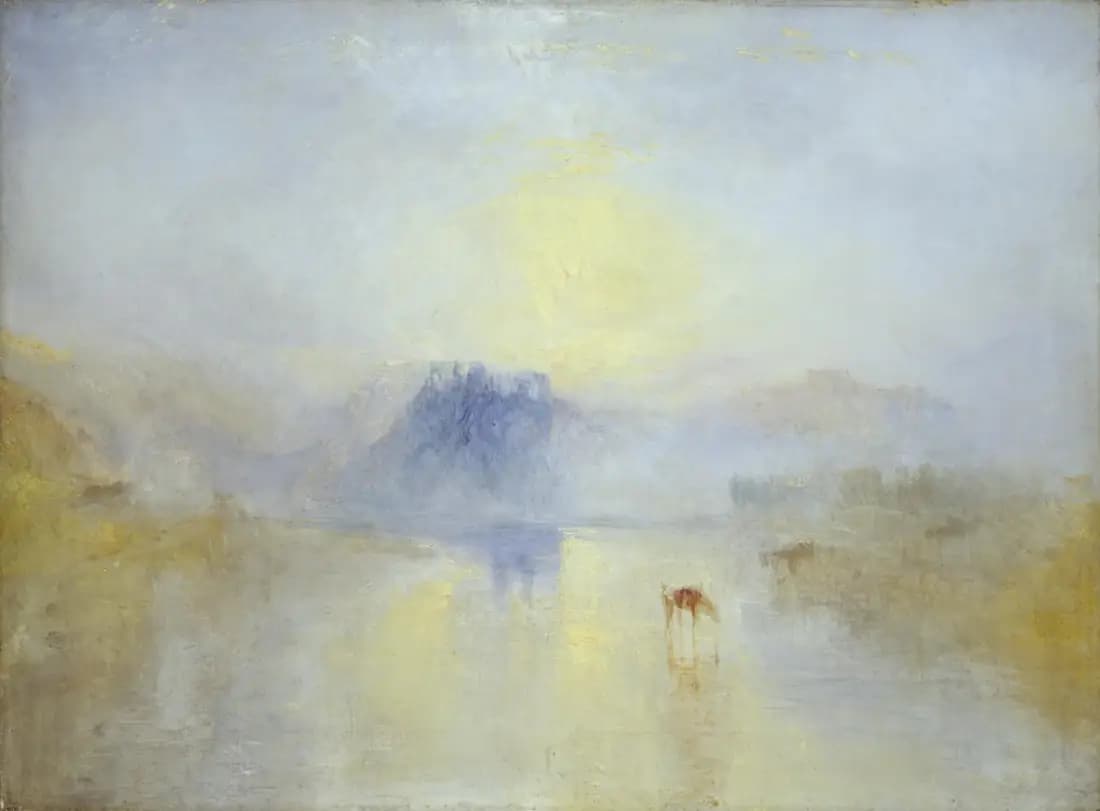
Turner first visited Norham in 1797 and used the castle in watercolours and prints. The border ruin became one of his recurring motifs. This version belongs to a group of late canvases found in his studio, where familiar places are reduced to light, colour and a few anchoring forms.
Finding the landscape gradually
The sun glows above the river, mirrored below in a broad vertical band. Cattle stand in the shallows at left, a boat may be emerging near the centre, and the keep hovers on the horizon. Turner lets recognition occur after atmosphere rather than before it.
Finished or unfinished?
The painting was not exhibited in Turner's lifetime and may be unfinished. That status should not be mistaken for failure. Thin veils, visible canvas and unresolved edges make sunrise the active subject, while the castle's history of conflict recedes into a morning that seems to rebuild the scene from almost nothing.
A castle almost returned to light
Turner knew Norham from earlier visits and had painted it in more descriptive forms. In this late version, the castle is barely a pale silhouette above the river. A cow in the foreground and a few darker banks provide just enough orientation. Recognition emerges slowly, as it might when dawn dissolves mist before details become certain.
The painting remained in Turner’s studio and may not have been considered finished in the conventional exhibition sense. That status should not make its openness accidental. Thin colour, exposed ground and softened edges create a complete experience of light taking precedence over object. The ruin does not disappear entirely. It holds the horizon while atmosphere changes what historical architecture can look like.
Sources and further reading
- Tate collection entryObject, recurring subject, date and unfinished status.
- Tate, Turner and NorhamSite history and Turner's repeated studies.