Look for actions, not a total
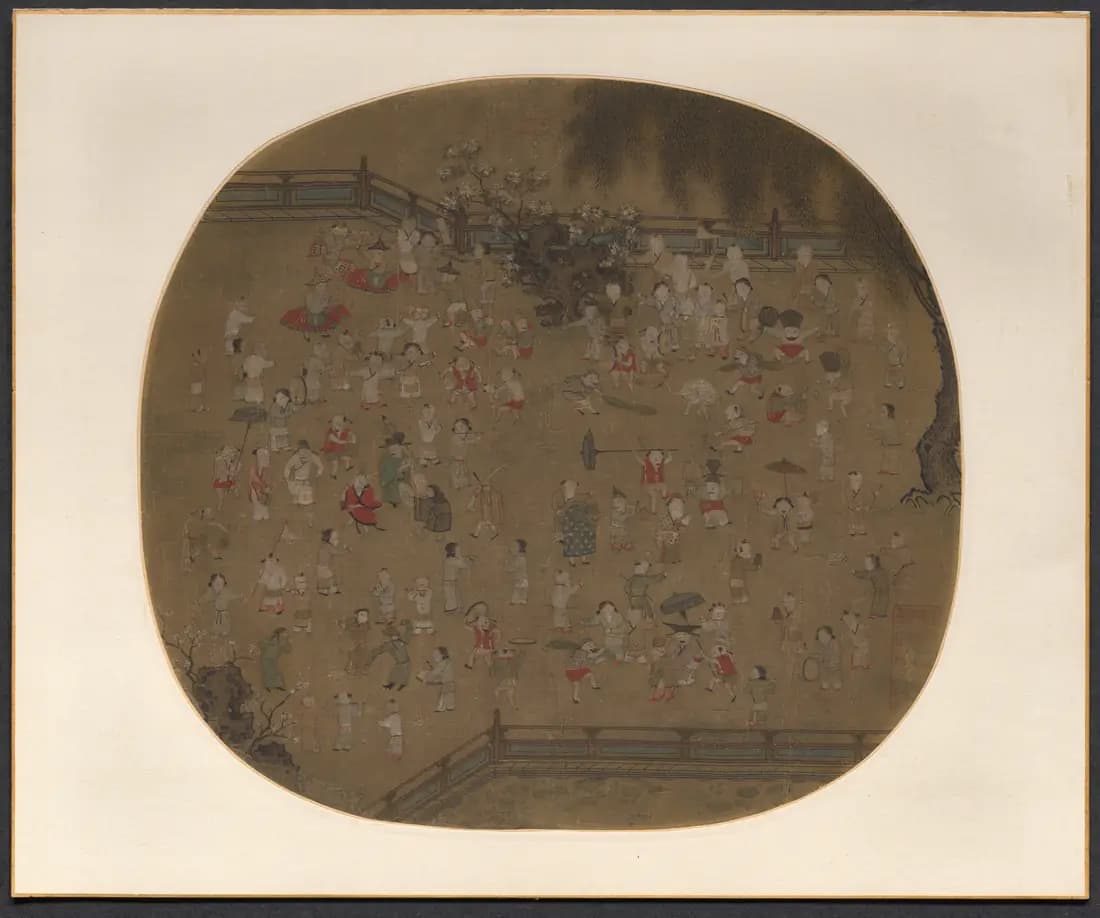
The scene invites counting, but the title does not promise exactly one hundred bodies. In Chinese visual tradition, the number could express abundance, continuity, and wishes for many descendants. Cleveland notes that such a painting might be given when a child reached one hundred days old or celebrated a first birthday.
The better way into the image is to follow activities. Children carry banners, handle toys, make music, stage processions, and form shifting groups across the garden.
Play rehearses adult society
Many games imitate grown-up ceremonies and occupations. Costumes, instruments, and formal gestures let children temporarily occupy roles they observe around them. The result is affectionate, but it is also structured: play becomes a small rehearsal for social life.
The Metropolitan Museum describes later versions of the Hundred Children theme combined with calligraphy, painting, music, and the game of go. That long afterlife shows how easily the subject could carry both delight and instruction.
Crowding remains legible
Although dozens of figures occupy a small silk surface, bodies rarely overlap enough to become confused. Pale ground and open paths separate clusters. A raised terrace, trees, railings, and rocks organize the eye without turning the garden into rigid boxes.
That clarity is a technical achievement. Faces and hands are tiny, yet changes in posture make each action readable. The artist builds abundance by accumulation while preserving space around individual gestures.
A tradition can have more than one name
The museum places the leaf in the traditions of Su Hanchen and Wang Juzhen rather than claiming a secure hand by either artist. Both names are associated with paintings of children in the Southern Song period. The wording acknowledges a recognized visual lineage while keeping the attribution honest.
That uncertainty does not weaken the image. It reminds us that subjects and methods traveled through workshops, copies, and later judgments. The children remain specific in their play even when the maker's identity cannot be reduced to one confident signature.
Sources and further reading
- Cleveland Museum of Art collection recordExact object, attribution, gift occasions, activities, and garden composition.
- Metropolitan Museum of Art, One Hundred Chinese BoysThe auspicious Hundred Children tradition and later combination with cultivated activities.