Rain without raindrops
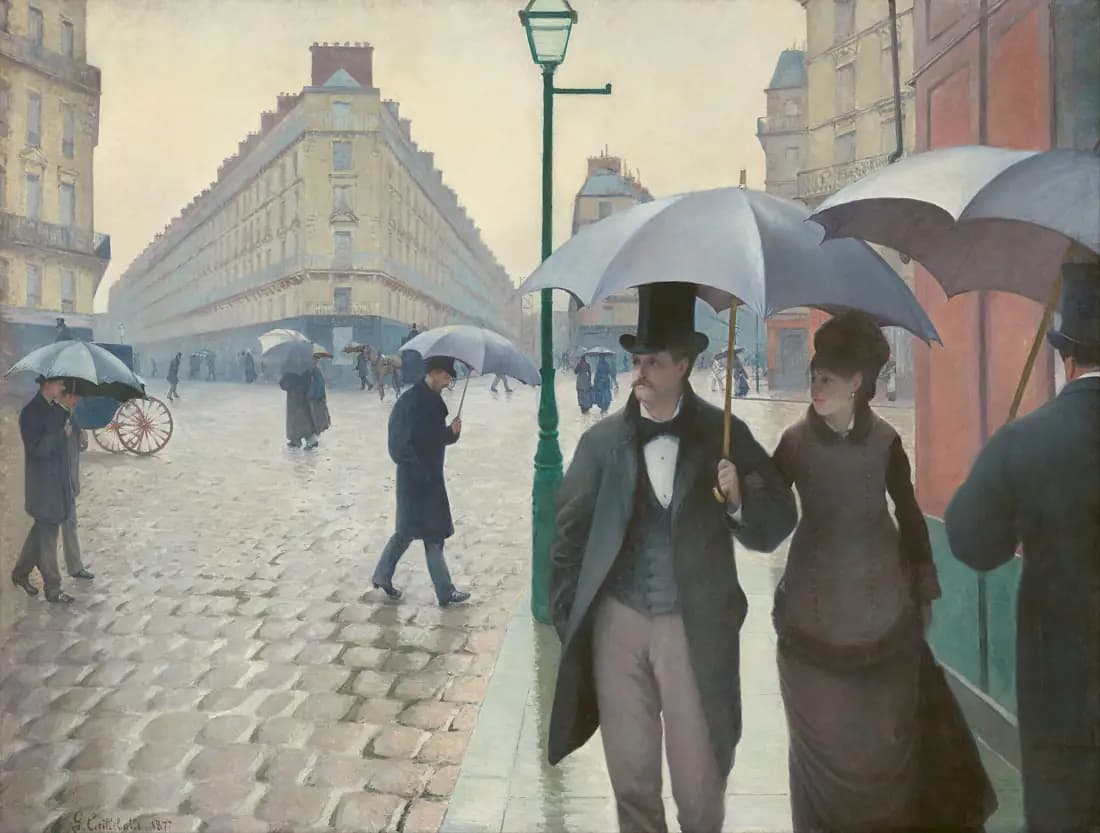
The umbrellas tell us first. Then come the blue-grey reflections on the cobbles, the darkened clothes and the cold sheen of the street. Caillebotte makes the weather unmistakable without drawing rain through the air. Some critics at the 1877 Impressionist exhibition complained about that absence, but it is one reason the scene feels suspended rather than theatrical.
The couple in front seem close enough to step into our path. A man at the far right is cropped as sharply as somebody caught at the edge of a photograph. Farther away, the figures repeat in a loose zigzag, shrinking rapidly into a city that feels both open and strangely isolating.
A lamppost divides the modern city
The enormous lamppost near the centre is not decorative. It splits the canvas while the streets and buildings pull the eye into depth on either side. Caillebotte planned those lines carefully through drawings and a painted study, adjusting the architecture and the positions of people before working at the scale of the final canvas, which is nearly three metres wide.
The intersection was part of the rebuilt Paris of broad streets and uniform stone façades. It had no official name in Caillebotte’s lifetime; today it is Place de Dublin, near the Gare Saint-Lazare. The new space promises movement and visibility, yet almost nobody looks at anyone else.
A frozen instant, repeatedly revised
The painting can resemble a camera snapshot, but technical examination reveals patient construction. Infrared and X-ray images show changes beneath the surface. The umbrella spike of the cropped man at the right was tried in three positions. Elsewhere, Caillebotte left spaces for figures and painted the background around them.
That mixture of strict geometry and interrupted movement is the painting’s tension. The street is orderly; the encounter is accidental. Everyone shares the same weather and almost the same pace, but each person seems sealed beneath a separate umbrella.
Sources and further reading
- Art Institute of Chicago collection recordObject data, scale and collection history.
- Art Institute scholarly catalogueSite, composition, preparatory work, criticism and technical imaging.
- Art Institute conservation videosTreatment and discoveries beneath the surface.