The trunk sets the screen in motion
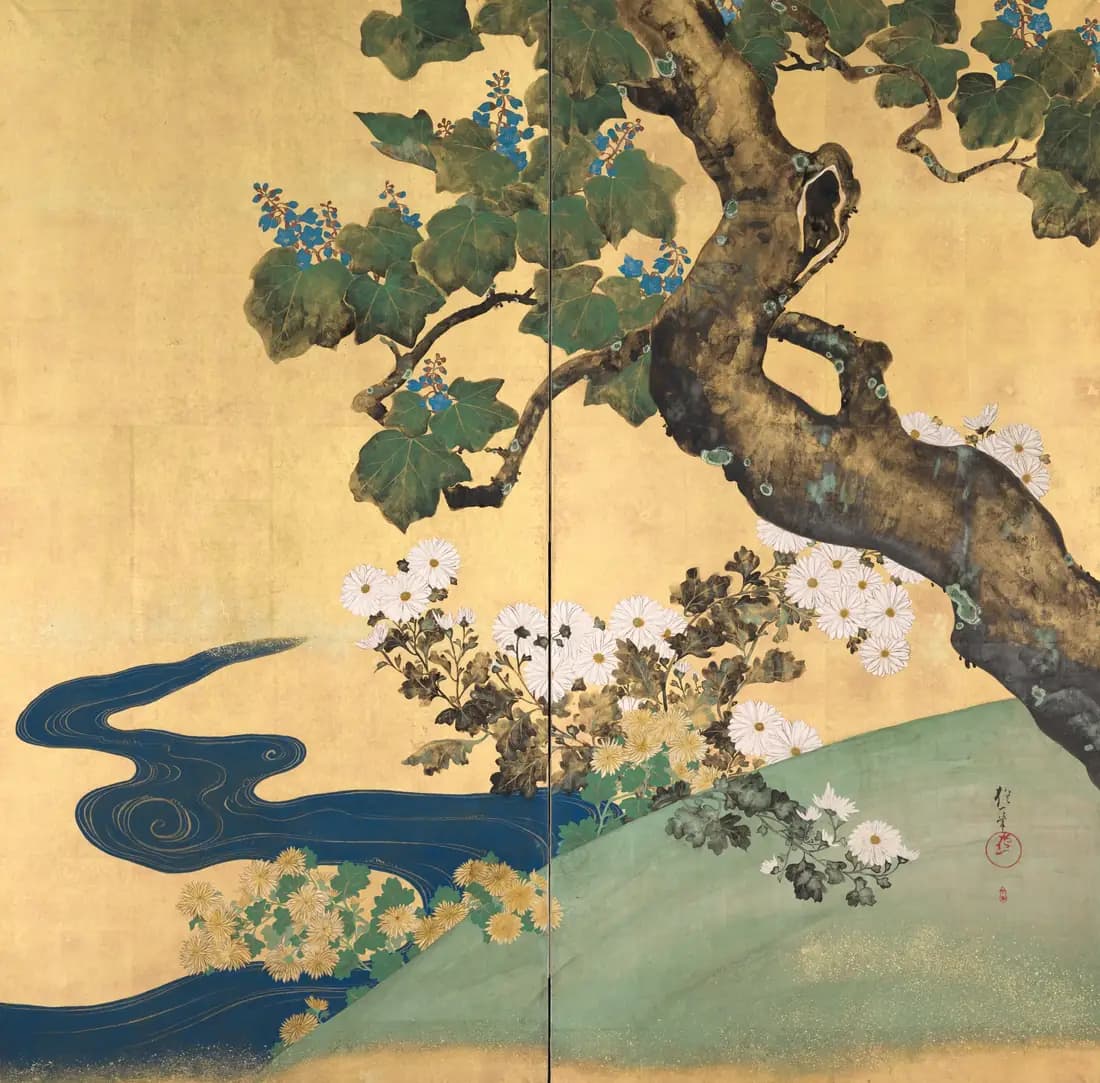
A thick paulownia rises from the right and leans across the central fold. Its branches press against the upper edge while a blue stream answers with a smaller curve below. Hōitsu makes the composition feel cropped from a living garden rather than arranged inside a frame.
White chrysanthemums interrupt the dark trunk and green bank. Some flowers face us, others tip sideways, and scattered petals loosen the border between plant and ground. The gold field supplies light without describing sky or distance.
Pooling paint makes a surface
The mottled bark and leaves depend on tarashikomi, or dripping-in. Hōitsu placed ink and color into areas that were still wet, allowing pigments to spread, pool, and form irregular edges. The technique turns controlled timing into textures that cannot be drawn line by line.
A related maple painted by Hōitsu's pupil Sakai Ōho uses the same mottled method to make velvety bark. In both works, accident remains bounded by design: liquid marks feel organic because the painter decides where they may move.
Two seasons meet
The Cleveland Museum identifies paulownia with late spring and chrysanthemum with early autumn. They do not document one moment in a single garden. Their meeting lets a compact screen hold seasonal change rather than a fixed afternoon.
Both plants also carried associations beyond weather. Paulownia and chrysanthemum served as emblems of the Japanese imperial house. The museum further connects paulownia with medicinal use and fortitude, and chrysanthemum with good government. Those meanings accompany visible differences in age, weight, and delicacy.
A folding object shares the room
This is a two-panel screen, not a flat canvas conceived only for a wall. Its central hinge can open at different angles, changing the blue stream and the long diagonal of the trunk as a viewer moves through the room.
Hōitsu often made this compact format for urban clients with less space. Scale becomes part of the invention: an old tree, a bank of flowers, moving water, and several seasons occupy an object that could stand, fold, and travel. The screen makes abundance from careful compression.
Sources and further reading
- Cleveland Museum of Art collection recordExact screen, dimensions, tarashikomi, seasonal plants, emblems, and compact urban format.
- Metropolitan Museum of Art, Autumn MapleRelated Rinpa practice and tarashikomi in the work of Hōitsu's pupil Sakai Ōho.