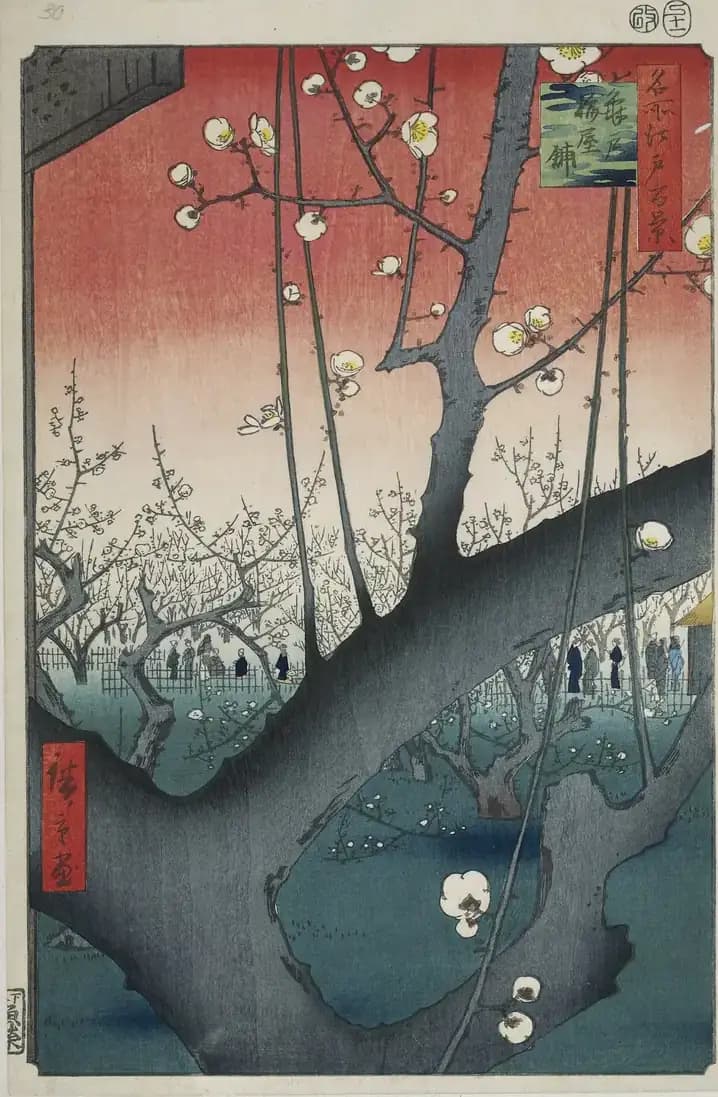
A celebrated tree at impossible scale
The foreground trunk belonged to the famous Sleeping Dragon Plum at Umeyashiki, or Plum Estate, in Kameido. Hiroshige enlarges and crops it until the branch behaves like architecture. Blossoms become small pale interruptions along a dark, muscular form.
The garden beyond the opening
Through the branch we see other plum trees, visitors and a low fence under a red horizon. The extreme contrast of scale gives depth without conventional perspective. It also recreates the physical act of looking around a close branch toward the seasonal crowd beyond.
From Edo print to Paris painting
Vincent van Gogh owned Japanese prints and copied this composition in oil in 1887. He strengthened the red and green, altered details and framed the scene with decorative characters taken from other prints. The comparison shows both Hiroshige's international influence and how boldly modern the original crop already was.
The foreground refuses to behave
The old plum trunk is too close to fit comfortably. It enters from below, leaves at the top and sends a branch sideways across the view. That aggressive crop makes distance feel newly vivid. Small visitors and delicate rows of flowering trees can only be reached by looking around the massive form that first blocks them.
Van Gogh copied the print because this construction offered more than an unfamiliar subject. It showed how flat colour, abrupt framing and large empty zones could organise space without conventional European modelling. In his painted version he intensified the hues and added a border of characters. Comparing the two makes Hiroshige’s restraint easier to see: the original’s force comes from placement before colour becomes loud.
Sources and further reading
- Rijksmuseum collection recordHiroshige impression, title and series context.
- Van Gogh Museum, Flowering Plum OrchardVan Gogh's painted copy and engagement with Japanese prints.