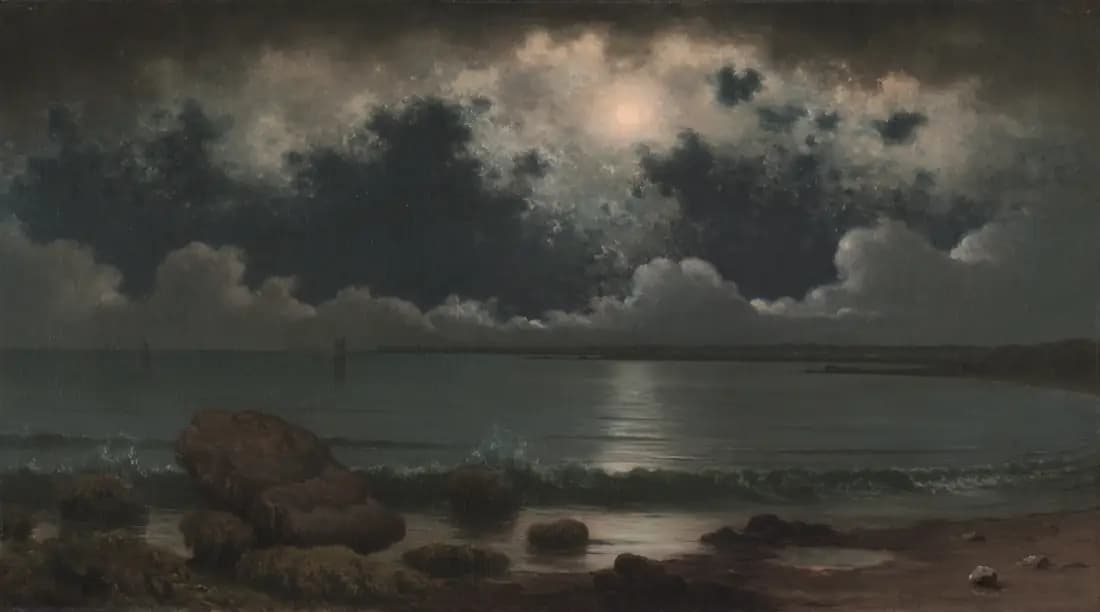
Moonlight organizes the sea
Clouds obscure the moon without extinguishing it. Light gathers around the hidden disc, drops in a narrow reflection across the calm water, and catches a few small waves before reaching the rocks. The rest of the coast is built from close shades of gray, blue, brown, and green.
Two sailing ships sit far to the left. Their near disappearance gives the open water its scale and shifts attention away from narrative toward the act of seeing in low light.
A named place becomes hard to locate
Point Judith is a real headland on the Rhode Island coast, but Heade withholds the landmarks that would make the view easy to map. The Cleveland Museum notes that shadow submerges the specific location so thoroughly that atmosphere becomes more important than topography.
The title anchors us while the image loosens that anchor. Place survives as rock, sea, horizon, and weather rather than as a checklist of recognizable features.
A nocturne was unusual for Heade
Heade spent much of his mature career painting New England shores and salt marshes. The National Gallery describes a long practice that moved among landscapes, seascapes, still lifes, and closely observed natural subjects. Yet only a handful of his landscapes are nocturnes.
Night changes the habits associated with his art. Meticulous observation remains, but reduced visibility makes certainty impossible. The viewer must wait for distinctions to emerge from darkness.
Reflection turns outward and inward
A National Gallery study discusses this exact painting as an example of how moonlight invites imaginative reflection. Unlike sunlight, the moon can be faced directly, while its borrowed glow makes the landscape itself feel like a reflector.
The painting does not prescribe a religious or emotional meaning. Its quiet depends on leaving the space open. The clouded moon is both a source we can see and a light we receive indirectly, making the physical coast a setting for inward attention.
Sources and further reading
- Cleveland Museum of Art collection recordExact work, ships, Rhode Island setting, rarity among Heade's nocturnes, and the priority of atmosphere.
- National Gallery of Art, American moonlight landscapesDiscussion of this exact Point Judith painting, reflected moonlight, imagination, and inward viewing.