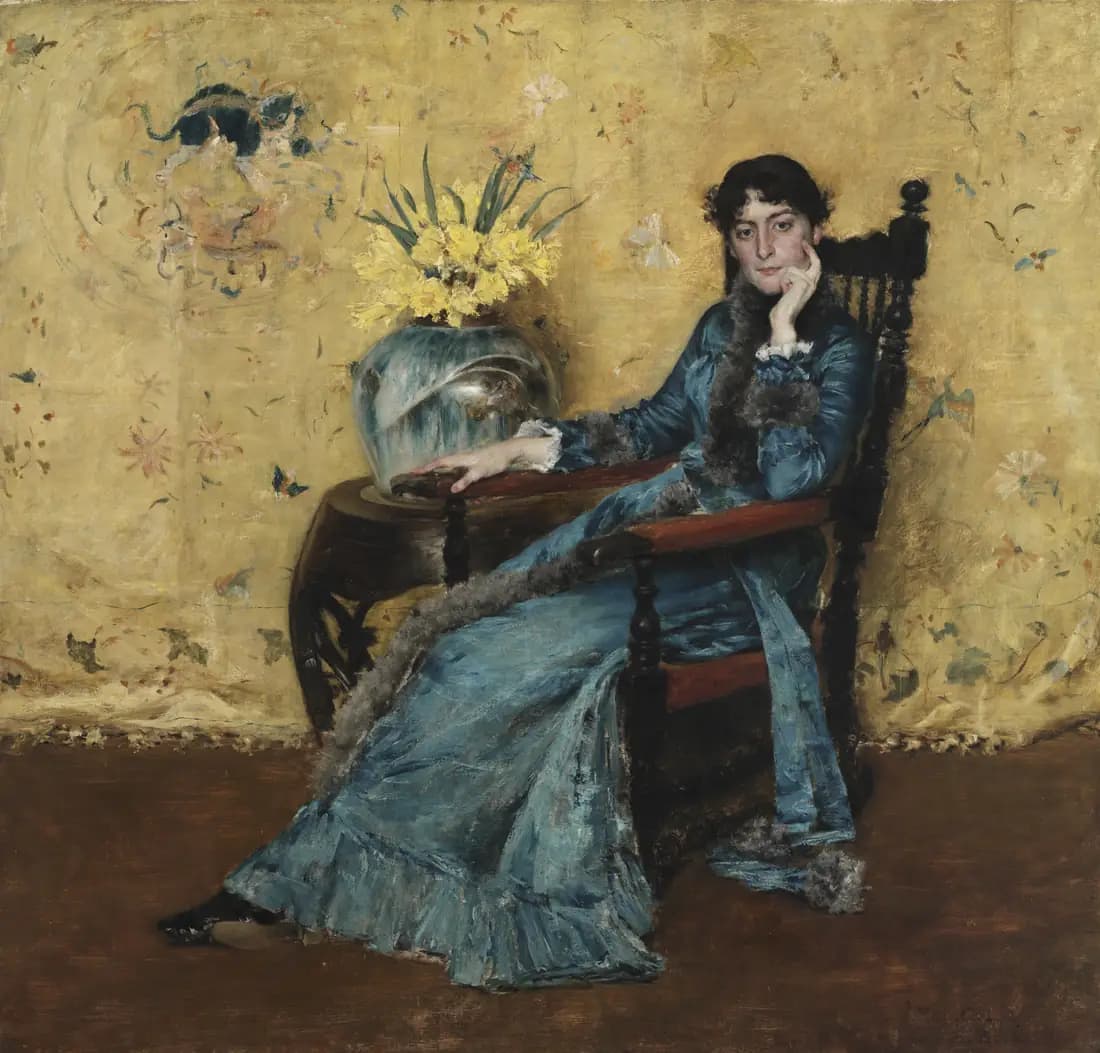
Color makes an entrance
Dora Wheeler's dress is an intense turquoise blue, set against a gold textile and dark surrounding field. Yellow flowers pick up the background's warmth, while her face and hands form quieter points between those saturated areas. Chase uses the palette to make the seated figure feel immediate rather than distant.
Wheeler looks outward without a theatrical smile. The pose is composed, but her direct gaze and the cropped arrangement give the portrait the confidence of a person occupying a professional world.
The sitter had been the painter's student
The Cleveland Museum identifies Wheeler as Chase's first student and notes how unusual it was for male artists of the period to accept women for private study. She was not only a pupil preserved by a famous teacher's canvas. She developed her own work as a painter, illustrator, and designer.
The portrait therefore records a relationship between artists. Its attention to Wheeler's presence is inseparable from the skills and ambitions she brought to the sitting.
The background names her profession
The embroidered silk behind Wheeler refers to the decorative arts in which she worked. With her mother, Candace Wheeler, she helped build a women-run design enterprise. The Met documents Dora among the younger designers associated with the firm, producing textiles, illustrations, and paintings rather than remaining confined to one medium.
Seen this way, the fabric is more than an expensive screen. Chase surrounds Wheeler with the category of work through which she helped shape American interiors.
A celebrated portrait returned with its sitter
The painting won a gold medal in Munich in 1883 and was later exhibited in Paris. International recognition helped establish Chase's reputation, but Wheeler remained connected to the object: she eventually owned it and gave it to the Cleveland Museum.
That provenance changes the final emphasis. The sitter was not merely the subject through whom the painter achieved success. She became the portrait's custodian and donor, helping decide where this image of her professional identity would enter public view.
Sources and further reading
- Cleveland Museum of Art collection recordExact object, sitter, teaching relationship, textile reference, awards, ownership, and gift.
- Metropolitan Museum of Art, Candace Wheeler exhibitionDora Wheeler's work and training within the women-run Associated Artists design firm.