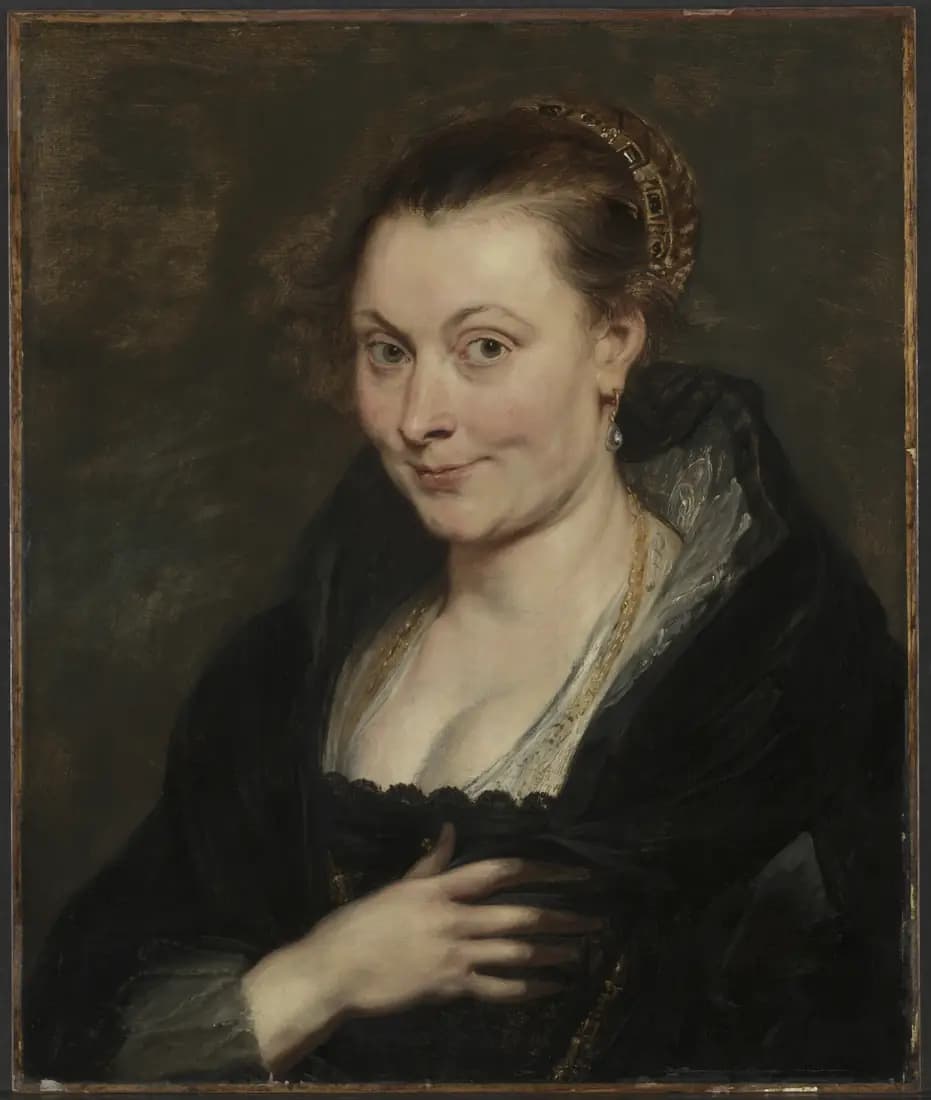
A face meets the viewer
Isabella Brant is shown close enough for the turn of her mouth and the alertness of her eyes to carry the portrait. Rubens avoids the columns, curtains, and costly accessories that often declare status in formal likenesses. A narrow white collar and small highlights at her sleeves punctuate clothing that otherwise dissolves into shadow.
The result feels immediate without being casual. Her head turns slightly, and the asymmetry keeps the expression alive, as though attention has just shifted toward us.
The panel records a revision
The Cleveland Museum explains that Rubens painted Brant's face first and added her hands later. The composition expanded as his conception changed. What now reads as a unified half-length portrait therefore began as a more concentrated study of her head.
The hands alter the encounter. Folded together, they introduce stillness and make the body present without competing with the face. The revision widened the portrait's emotional register.
The sitter shared the artist's life
Brant was Rubens's first wife. They married in Antwerp in 1609 and later bought the property where he created both a family home and a large studio. The Rubenshuis describes that house, garden, and workshop as a single lived environment shaped by the couple and their household.
Rubens represented Brant repeatedly, sometimes beside himself and sometimes alone. That familiarity does not give us unfiltered access to her personality, but it changes the nature of the commission. This was not a distant court sitter passing briefly through the studio.
Warmth survives loss
Brant died young, in 1626. Knowing that history can make every soft passage feel elegiac, although the painting was not conceived as a memorial. Its first task is presence: flushed skin, loose brushwork, and an expression poised between composure and amusement.
The portrait's power comes from resisting grand explanation. Rubens used the full resources of his painting to attend to someone he knew closely, then changed the object so that her hands could join her face.
Sources and further reading
- Cleveland Museum of Art collection recordExact portrait, sitter, date, medium, later addition of the hands, brushwork, and Brant's death.
- Rubenshuis, biography of RubensRubens's marriage to Isabella Brant and his Antwerp family and studio context.