The scale belongs to court portraiture
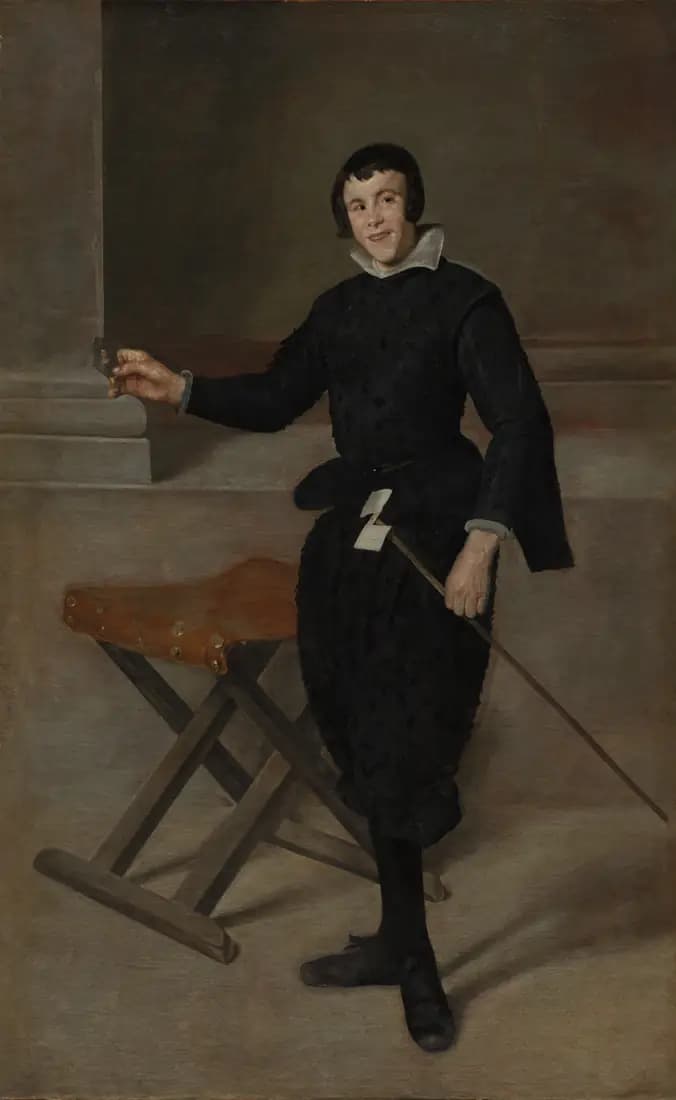
Calabazas stands nearly life-size against a space with few distractions. The full-length format was normally used to make status visible at court. Velázquez applies that formal scale to a man employed as a jester, placing his body and direct encounter with the viewer at the center of the canvas.
The Cleveland Museum identifies Calabazas as a member of Philip IV's household who had physical and mental disabilities. Historical court language often reduced such people to their assigned role. The portrait resists that reduction by making one individual occupy the whole field.
Two objects refuse to settle
In one hand Calabazas holds a pinwheel; in the other, a small portrait. The museum connects these objects to the inconstancy of love, a theme in which turning toys and exchanged likenesses could signal changeable affection. Yet they do not produce a complete narrative. We cannot confidently name the miniature's sitter or explain the exact game.
That uncertainty matters. The Prado describes ambiguity as central to Velázquez's portraits of court entertainers, which depart from the tightly controlled meanings of royal portraiture.
A person, not a court type
Velázquez painted several people who served the Spanish court as jesters or entertainers. Their position depended on a hierarchy that treated bodily and mental difference as spectacle. The paintings record that unequal world, but they do not all behave like caricatures.
Here the reserved pose and dark clothing give Calabazas a stillness that competes with the playful prop. Looking carefully means holding both facts together: his role shaped how contemporaries saw him, and the portrait grants him an attention that exceeds that role.
Dignity does not erase the history
It is tempting to call the painting modern because its sitter appears dignified. That praise can become too easy if it hides why Calabazas was at court. Velázquez worked inside a system that employed marginalized people for royal amusement, and the canvas cannot remove that condition.
What it can do is slow the viewer down. Monumental scale, direct presence, and unresolved objects deny a quick joke or a neat diagnosis. The result is a portrait whose humanity lies partly in how much it leaves open.
Sources and further reading
- Cleveland Museum of Art collection recordExact object, sitter, court role, visible props, format, and interpretation.
- Museo Nacional del Prado, The Buffoon CalabacillasVelázquez's portraits of court entertainers and their departure from royal portrait conventions.