A gaze deliberately turned away
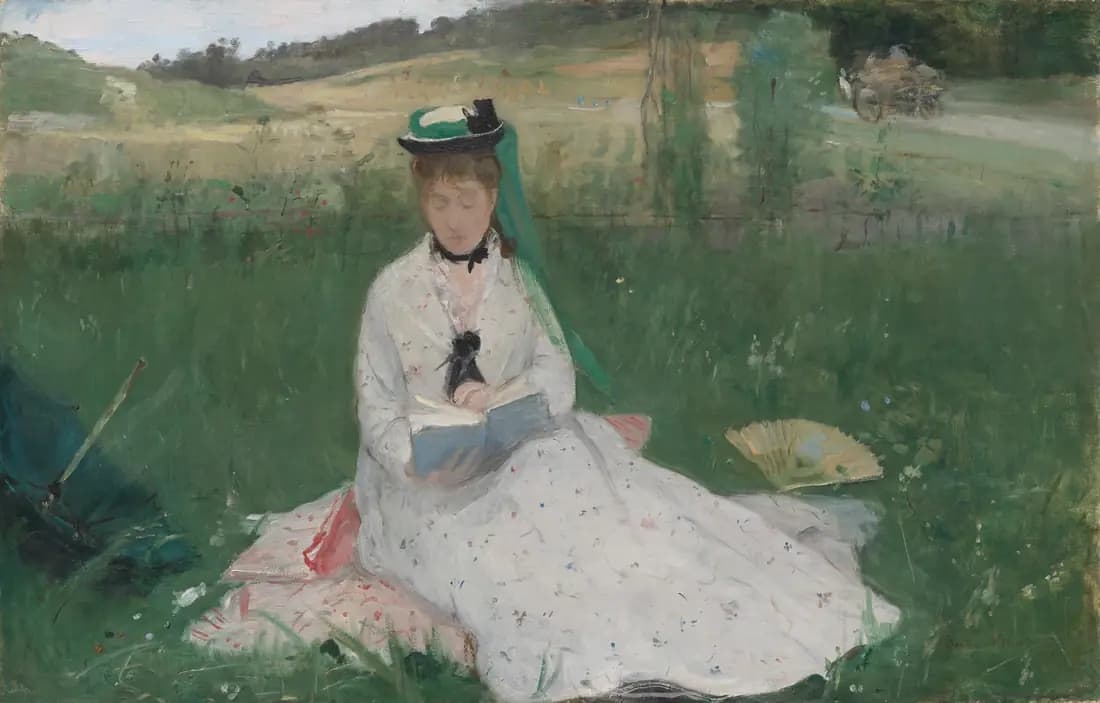
Edma Morisot sits low in the grass, holding a blue book while a parasol and fan lie beside her. She is close enough for a portrait, yet her lowered eyes refuse the usual exchange between sitter and viewer. We can study the green veil over her hat, the necklace at her throat, and the pale pages, but we do not interrupt her concentration.
An X-ray revealed that Berthe Morisot revised this relationship. Edma's eyes first looked outward, more like the direct gazes associated with Edouard Manet's figures. Morisot repainted them toward the book. That small change gives the finished scene its privacy.
White is made from the meadow
Edma's dress is the brightest shape, but it is not a flat patch of white. Blue-gray shadows, small floral marks, and touches of surrounding green break across the fabric. Its pattern answers the wildflowers and loose grass, so the figure remains distinct while still belonging to the outdoor light.
The face is much less finished than the hat, book, or broad sweep of the dress. Morisot lets quick strokes carry atmosphere instead of sharpening every feature equally. The painting asks us to recognize a person through posture and attention as much as through a detailed likeness.
The sitter was also the artist's sister
Edma and Berthe had trained as painters together, but Edma largely stopped exhibiting after marriage. Here she is neither an anonymous reader nor a staged literary heroine. Morisot paints somebody whose inner life she knew, absorbed in an ordinary activity available within the social world the sisters shared.
The Cleveland Museum notes that Morisot's subjects often reflect the constraints placed on women in her time. Reading does not need to turn those limits into a dramatic story. Its force comes from treating a woman's uninterrupted thought as enough to sustain a large field of paint.
A quiet work entered a radical exhibition
Reading appeared in the independent exhibition of 1874 now associated with the beginning of Impressionism. Morisot was not a visitor to that experiment. She was one of the artists who chose to exhibit outside the official Salon system and later participated in seven of the group's eight exhibitions.
Nothing in this meadow announces rebellion with a grand gesture. The challenge lies in what Morisot considered worthy of serious painting: unfinished-looking marks, changing outdoor light, a family member, and a moment that does not perform for us. Turning Edma's eyes toward the page completes that choice.
Sources and further reading
- Cleveland Museum of Art collection recordExact object, sitter, materials, visible details, X-ray finding, and social context.
- National Gallery of Art, Paris 1874The first Impressionist exhibition and Morisot's place in the independent group.
- National Gallery of Art, The Mother and Sister of the ArtistEdma Morisot, the sisters' circumstances, and Morisot's participation in the Impressionist exhibitions.