Two trees, two characters
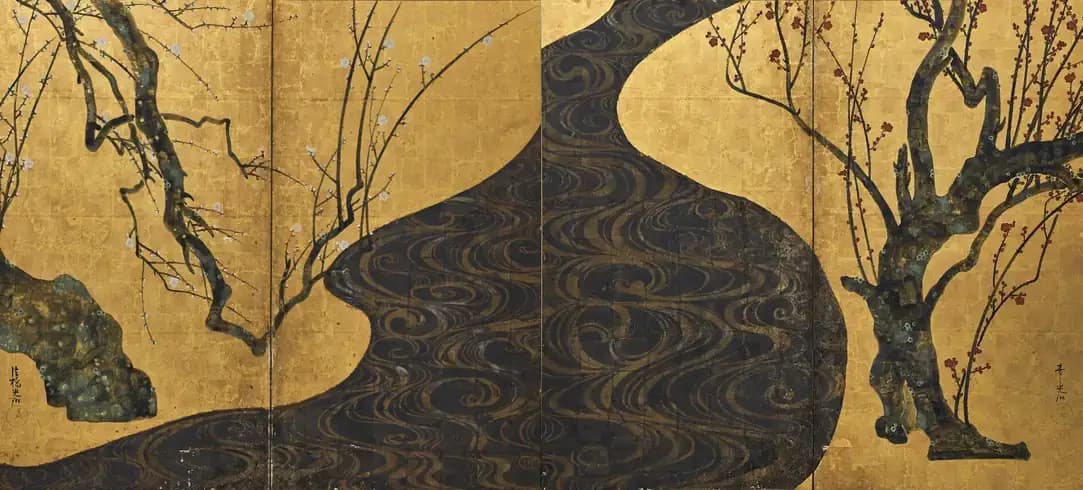
At right, an old plum trunk bends and splits, carrying red blossoms along dark bark. At left, a smoother younger tree rises with white flowers. The river prevents the pair from becoming a simple mirror while its curves bind them across separate screens.
A river changed by chemistry
Korin used silver for the water, contrasting its cool reflection with the gold ground. Silver tarnishes, so the stream has darkened over time. The change is now inseparable from the work's familiar appearance, a reminder that historical colour is not always the colour visible today.
Nature reduced and intensified
There is no horizon and almost no descriptive setting. Patterned waves, pooled mineral colour and carefully placed blossoms turn natural forms into a decorative structure without making them lifeless. Korin's wet-in-wet tarashikomi technique creates mottled trunks whose spreading tones suggest bark, age and moisture within the flat gold world.
A pair that changes as screens fold
Photographs flatten the work into one wide image, but each half is a folding screen. In a room, its panels would turn slightly, catching light differently across gold and changing the apparent distance between river and trees. The composition therefore belongs to architecture as well as painting. Its empty areas become active when the viewer moves.
The blossoms are individually small but distributed with great control. Red clusters follow the older trunk, while white blooms punctuate finer branches across the stream. Neither tree is complete within one glance because branches leave the edges and return attention to the dark water. Renewal is not represented by a generic field of spring flowers. It happens as a tense exchange between two particular forms.
Sources and further reading
- MOA Museum of Art collectionNational Treasure, materials, screens and collection context.
- The Metropolitan Museum of Art, Rinpa artKorin, tarashikomi and Rinpa design.