A mountain caught at dawn
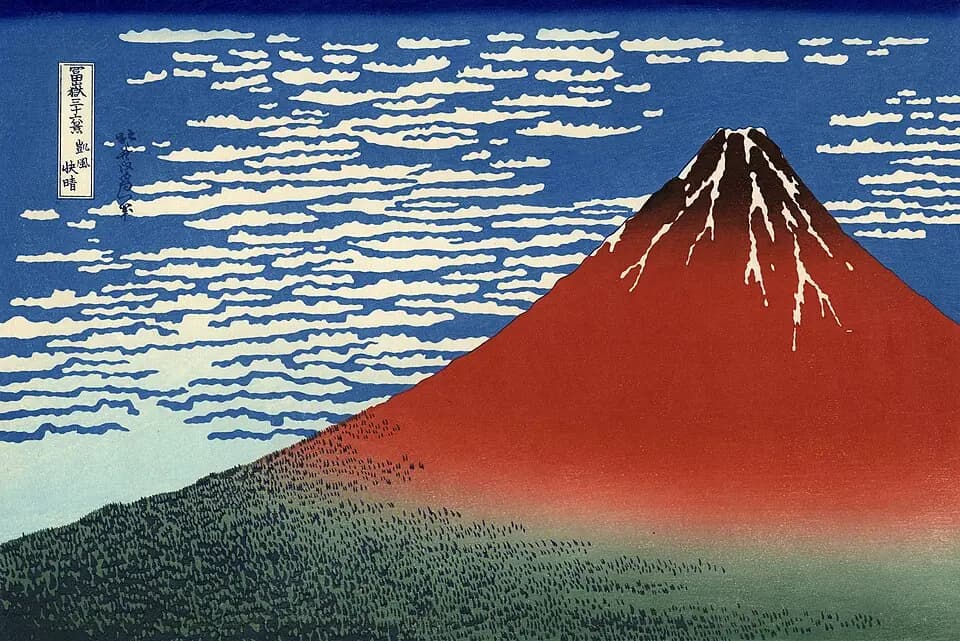
Under the right conditions in late summer or early autumn, the rising sun can briefly wash Mount Fuji’s upper slopes red. Hokusai sets that rare light against a blue morning sky filled with bands of high altocumulus cloud. In Japan, this pattern is sometimes called a “mackerel sky” because its small, repeating clouds resemble the markings on a fish.
The boundary between light and shadow curves across the mountain rather than cutting straight through it. Fuji is a cone, and the early sun reaches its sloping surface at an angle. The tiny green triangles at the foot of the mountain are trees; their scale makes the uninterrupted red slope feel immense.
Everything unnecessary has disappeared
Many prints in Hokusai’s Thirty-six Views of Mount Fuji are alive with travellers, fishermen, rooftops and roads. Here there is nobody. There are no buildings and no foreground story. Mountain, trees, clouds and sky are enough.
That absence gives the image its unusual stillness. It also makes every decision more visible: the dark blue contour pushing the summit forward, the sparse veins of snow and the unevenly printed sky that lets the clouds appear to drift.
A modern blue in an old print
Red Fuji was made as a colour woodblock print, with separate carved blocks carrying different inks. Scientific examination has identified Prussian blue in the mountain’s outline and in the green lower slope, where blue was mixed with a yellow pigment. Prussian blue was a relatively new synthetic colour in Japanese commercial printing, and Hokusai’s Fuji series helped demonstrate how powerfully it could shape a landscape.
Sources and further reading
- British Museum collection recordObject history, title, series and print details.
- British Museum conservation researchPigments, printing differences and conservation.
- The Metropolitan Museum of ArtA second institutional object record and impression.