One bird carries the whole past
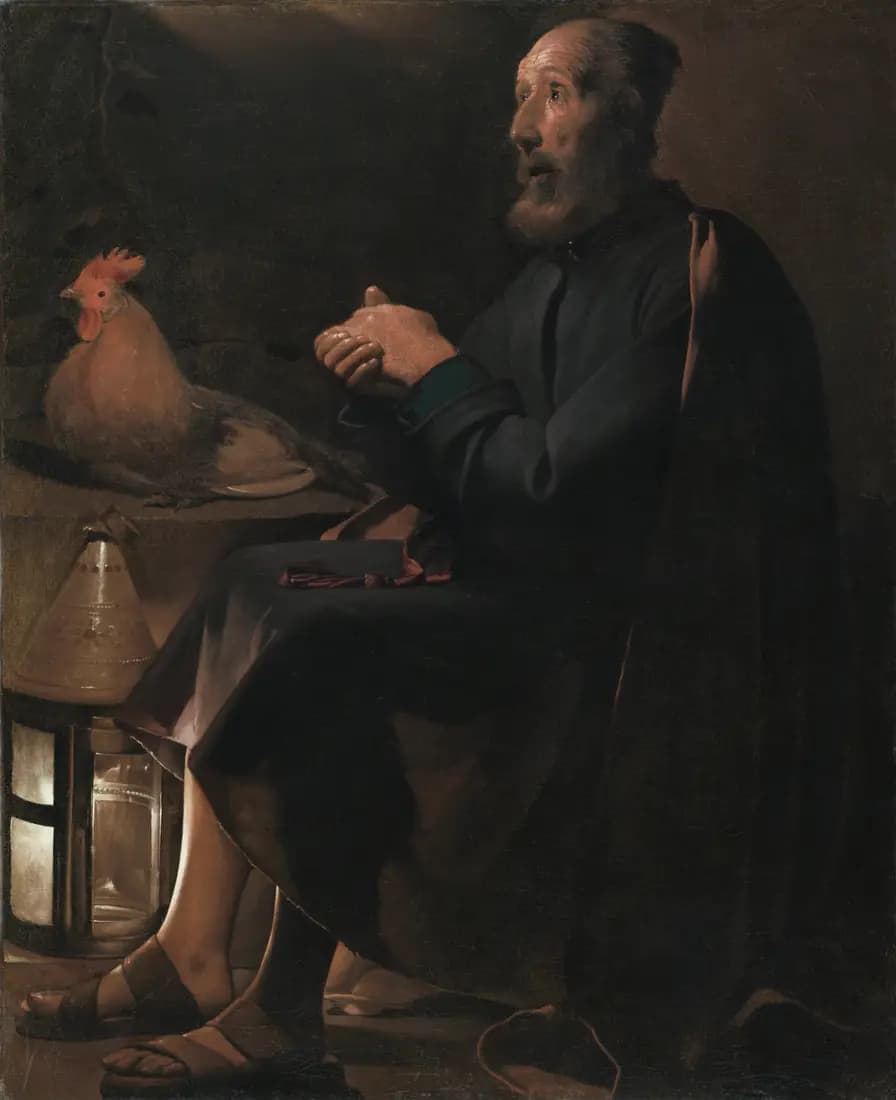
Peter is an old man seated in a dark room. His hands are joined, his mouth slightly open, and his eyes reddened. The rooster beside him identifies the story: during Jesus's arrest, Peter denied knowing him three times before the bird crowed, just as Jesus had predicted.
La Tour does not show the accusation, the courtyard, or the instant of denial. He paints what memory does afterward. The rooster remains physically near Peter, turning a brief sound from the past into a companion he cannot dismiss.
The light does not offer certainty
A lantern near the floor illuminates Peter from below. Its warm light finds his forehead, nose, hands, sleeve, and the rooster's red comb, then loses almost everything else in brown-black shadow. The source is partly enclosed, so it glows rather than flares.
This limited light slows the scene. We have to wait for objects to separate from darkness, much as Peter appears trapped in repeated thought. Illumination reveals enough for recognition but does not transform remorse into a bright resolution.
Repentance has lasted into old age
The biblical denial happened around the time of the Crucifixion, but La Tour represents Peter as aged and worn. The Cleveland Museum describes him in a state of continuing repentance rather than at one documented instant. Time has become visible in his face, beard, and heavy posture.
That choice avoids theatrical panic. Peter's emotion is contained in small physical signs: damp eyes, raised brows, parted lips, and fingers pressed together. The picture asks how one lives after forgiveness when memory itself remains active.
A night painter working far from Rome
La Tour spent most of his career in Lorraine in northeastern France. His candlelit figures are often compared with Caravaggio and later painters shaped by Caravaggio's dramatic darkness, but the exact route of that influence remains unclear. The museum is careful not to invent a direct encounter.
A related painting at the National Gallery of Art shows the repentant Mary Magdalene beside a candle, skull, book, and mirror. Comparing the two reveals La Tour's restraint. Different objects identify different lives, while a single hidden or shielded flame turns each room into a place where thought is more active than action.
Sources and further reading
- Cleveland Museum of Art collection recordExact object, biblical subject, rooster, age, lantern, expression, and cautious Caravaggio context.
- National Gallery of Art, The Repentant MagdalenA related candlelit repentance subject and La Tour's use of symbolic objects and controlled light.
- National Gallery of Art, Georges de La Tour and His WorldInstitutional context for La Tour's work among seventeenth-century contemporaries.