A cathedral under pressure
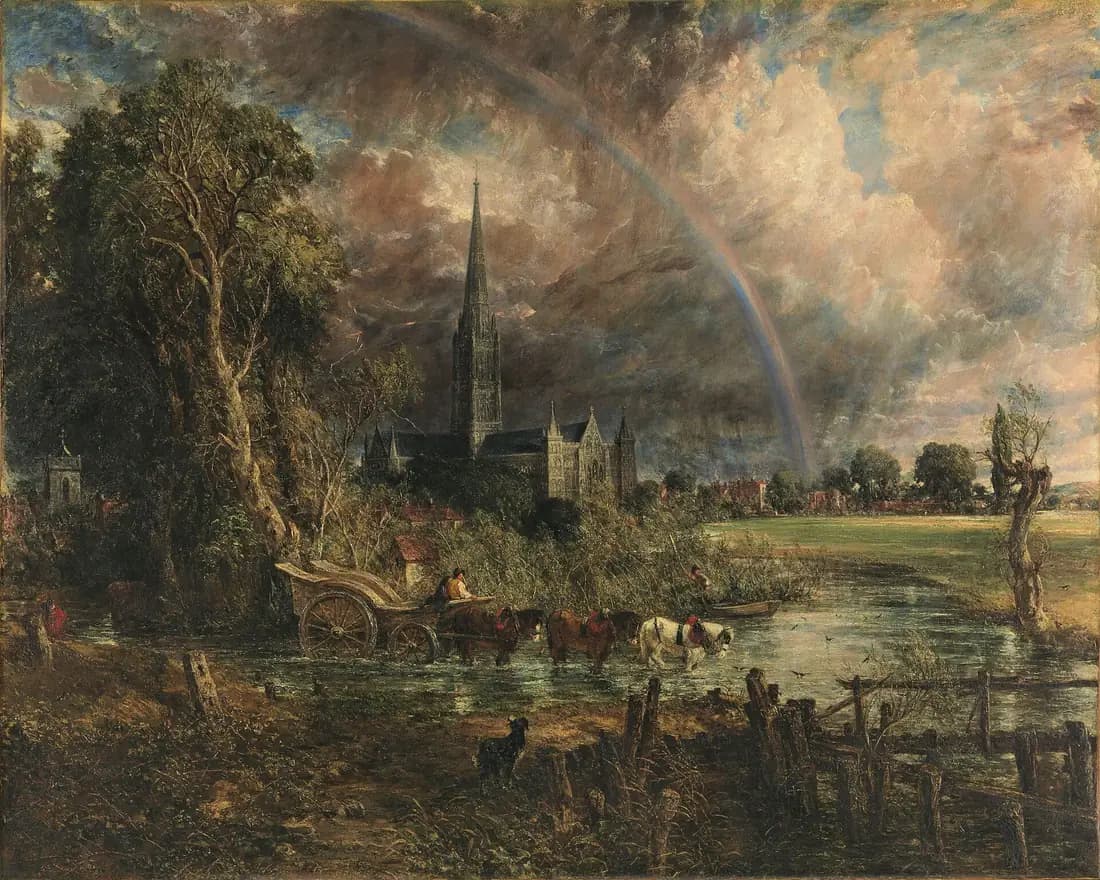
Salisbury's spire remains the composition's vertical anchor, but dark cloud and streaking rain threaten its clarity. Constable worked during arguments over reform in the Church of England and described the painting in emotionally charged terms. The landscape carries that tension without becoming a simple political cartoon.
The difficult road in front
A team pulls a cart through water at the lower left while a dog watches from the bank. These small figures give the foreground resistance and effort. The river reflects fragments of light, but fallen branches and rough vegetation prevent an easy pastoral path toward the cathedral.
A rainbow aimed at friendship
The rainbow was added after the first exhibition and bends toward the house of Constable's friend Archdeacon John Fisher. It may offer hope, tribute or reconciliation after storm. Because the weather is physically impossible in some details, it is best read as composed meaning rather than a record of one observed sky.
A storm assembled into a moral landscape
The painting gathers events that need not have occurred together: turbulent clouds, flooded ground, a dog, a cart, a grave and a rainbow aimed toward the cathedral. Constable builds coherence through recurring curves and diagonals rather than meteorological probability. The rainbow answers the arch of dark weather while the spire pins both to the landscape.
Contemporary debates about the Church of England gave the cathedral political as well as spiritual weight. Yet the image resists becoming a diagram of one position. The building is distant, the foreground route is difficult and hope appears only through unstable light after storm. Constable’s friendship with Archdeacon John Fisher adds a personal layer, making public institution and private feeling share the same weather.
Sources and further reading
- Tate collection entryObject, politics, Fisher and rainbow.
- The Met, John ConstableMuseum context for Constable's landscape practice.