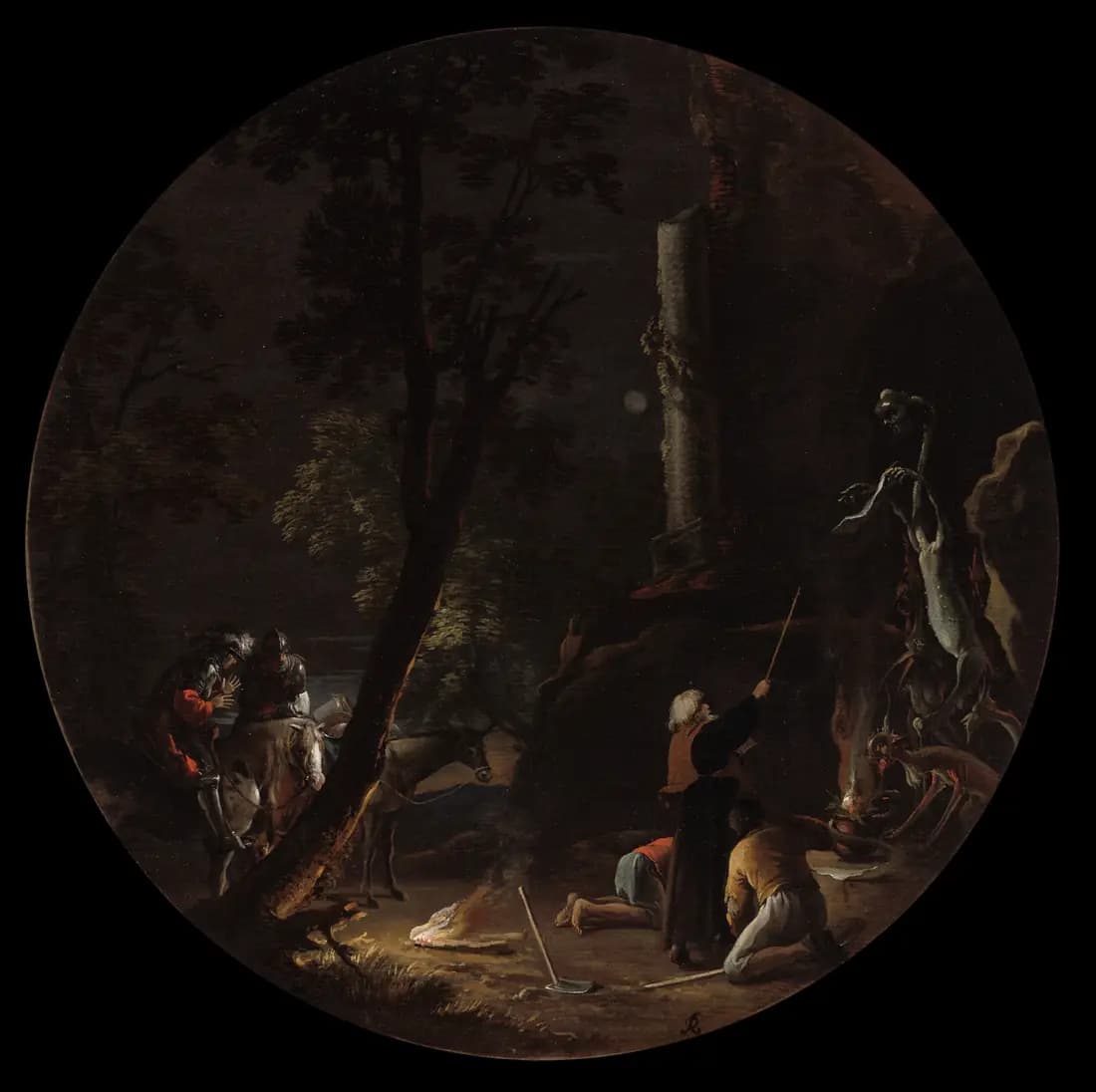
Two groups meet at the edge of belief
On the left, armed travelers pause with a horse and donkey. Near the center, men gather around a small fire and the remains of a classical column. One tall figure raises a rod toward a hanging skeleton and winged apparitions. The travelers can see what we see, but their distance lets them hesitate between witness and escape.
Rosa keeps most of the forest almost black. Fire, moon, pale bodies, and flashes of clothing reveal only fragments, so the eye repeatedly loses and rediscovers the conjured world.
These magical figures are men
European witch imagery often centered women, but this scene turns to necromancy associated with learned male sorcerers. The Cleveland Museum describes the commanding magician as recalling Moses in earlier visual traditions. His long body and raised rod give the supernatural performance an unexpected air of authority.
That does not make the magic harmless. Skeletons, animals, and hybrid beings crowd the darkness. It does make the painting's subject more specific than a generic witches' gathering: knowledge, power, and the danger of intellectual ambition are part of the unease.
The circle is part of the spell
The canvas is a tondo, or circular painting. The museum connects that shape with the circle's foundational place in magical practice. Rosa therefore does not merely place a ritual inside a decorative format. The enclosing edge can itself suggest the boundary of an operation, sealing spectators, sorcerers, ruins, and apparitions into one dark field.
The work belongs to a set of four circular witchcraft scenes made around 1645-49. Their original arrangement is not documented, but they remained together. Repetition turns each episode into one phase of a larger investigation of magic rather than an isolated shock.
Conjuring becomes a claim for painting
Rosa cultivated a reputation for originality in Florence through painting, poetry, satire, and performance. The museum's research argues that these learned magicians could refer to the artist and his intellectual circle. A sorcerer produces forms no ordinary traveler expects to see; a painter does something related on a flat canvas.
That comparison is visible in the brushwork. Creatures emerge only where Rosa gives them enough light and shape, while darkness hides the rest. The painting turns its own making into part of the subject: invention can astonish, persuade, and disturb, whether the instrument is a wand or a brush.
Sources and further reading
- Cleveland Museum of Art collection recordExact object, figures, necromancy, Moses association, circular format, and artist-magician interpretation.
- Cleveland Museum of Art, The Novel and the BizarreThe four tondi, their Florentine context, visual precedents, original ownership, and Rosa's self-fashioning.
- Cleveland Museum of Art exhibition releaseInstitutional overview of the series, magic, satire, antiquity, and the macabre.