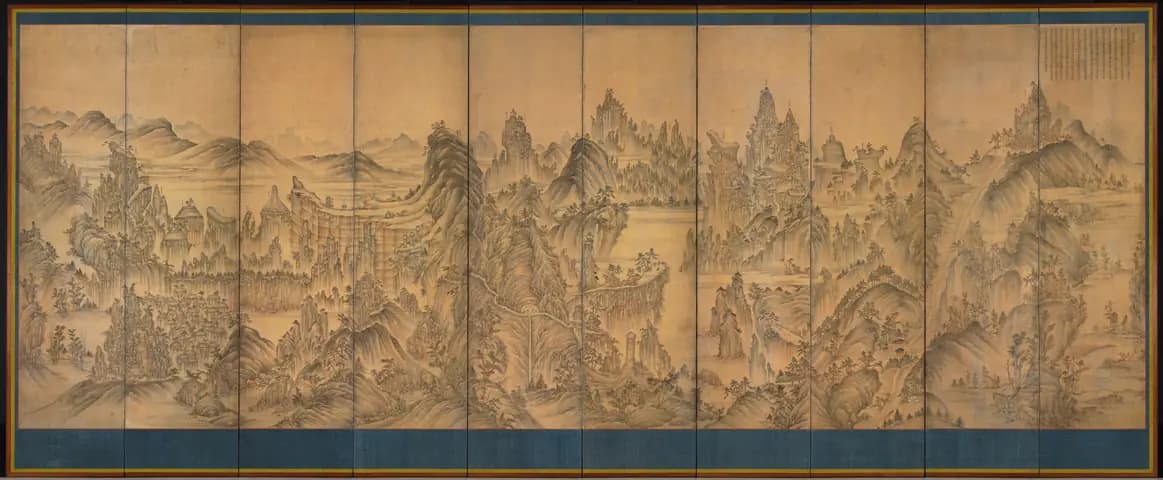
Ten panels assemble a journey
The screen opens into a long sequence of ridges, wooded slopes, roads, buildings, and water. Panel seams interrupt the silk at regular intervals, yet paths and mountain chains continue across them. Folding gives the landscape a measured rhythm without reducing it to separate scenes.
A bird's-eye viewpoint makes distant sites legible at once. No person standing in the terrain could possess this view. The composition brings mapped knowledge and pictorial invention together in an overview made for close inspection.
The shapes belong to geology
Seven Jeweled Mountain, or Chilbosan, was formed by ancient volcanic activity. The Cleveland Museum identifies pillar-like rocks, a flat-topped steep cliff, and rugged formations of metamorphic and igneous stone in specific panels.
Those facts keep the peaks from becoming a generic fantasy. The painter varies silhouettes, strata, vegetation, and routes to distinguish particular formations. Delicate brushwork serves topographical attention even when the total view exceeds ordinary sight.
A true view still transforms
The museum places the screen within Korea's true-view landscape tradition, which developed detailed portrayals of actual sites from the 1700s onward. True does not mean mechanically copied from one position. It means that a named place and its recognizable features guide the painting.
Cleveland's curatorial account explains that scholars and Buddhist pilgrims traveled to the mountain, and that officials commissioned painters to record its topographic features. The screen joins an inherited landscape language to the cultural value placed on experiencing a celebrated site.
Access changes what the screen can mean
The mountain became part of North Korea after the Korean War of 1950-53. Cleveland notes that the site has since moved beyond reach for most of the world. The screen now offers visual access that its nineteenth-century maker could not have expected it to carry.
That later history should not turn the painting into a transparent photograph or a substitute for the place. Its value lies in the tension between record and construction. A real mountain survives here as a carefully organized object, folded into ten movable parts and unfolded by a viewer far away.
Sources and further reading
- Cleveland Museum of Art collection recordExact screen, dimensions, topography, geology, true-view tradition, and postwar access.
- Cleveland Museum of Art, Into the Seven Jeweled MountainCuratorial discussion of Korean landscape painting, travel, viewpoint, and the screen's present context.