Two systems of light
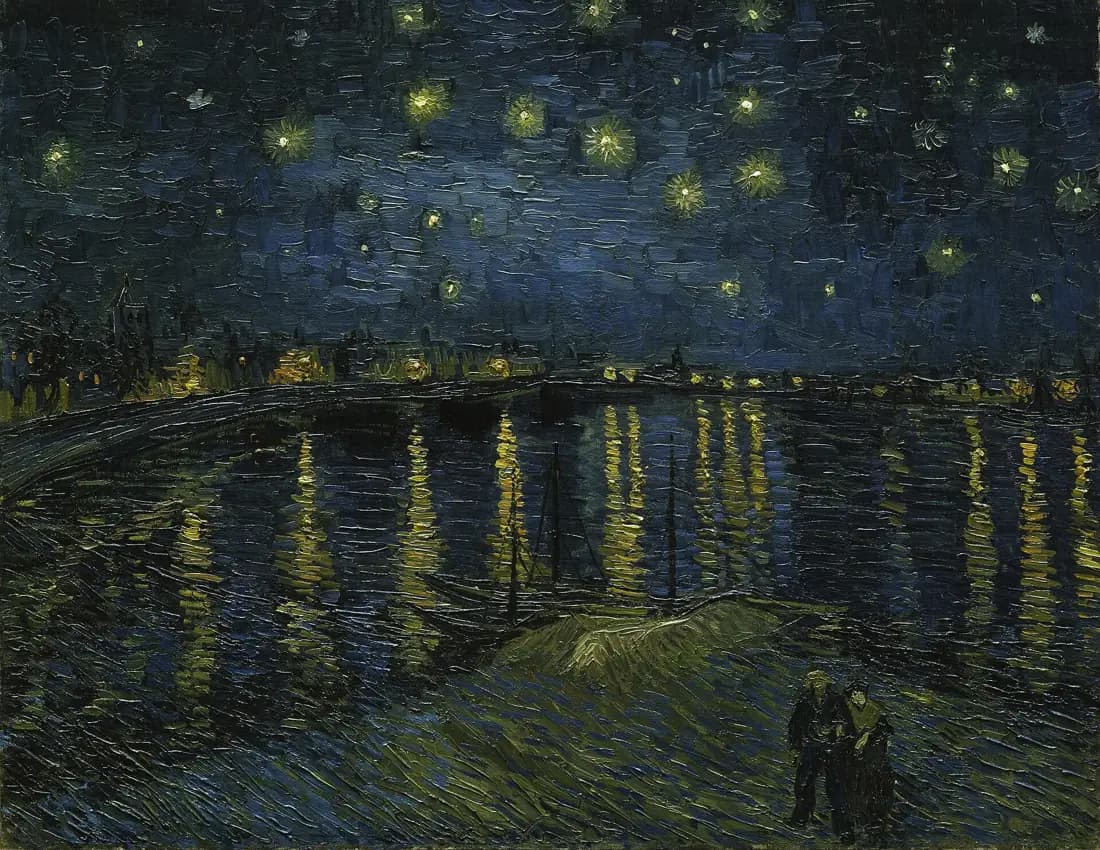
The Great Bear appears in the sky, while gas lamps along the Arles quay create golden reflections below. Van Gogh separates them through paint: stars radiate in compact halos, but city lights descend as broken vertical strokes. The river becomes a second sky altered by movement.
Painting night outside
Van Gogh wrote enthusiastically about finding colour at night rather than reducing darkness to black. Deep blues, violet, green and yellow organise the scene. He worked on the riverbank, and an acquaintance later recalled candles fixed around his hat, although the exact practical details of that method are difficult to verify.
A couple beneath the cosmos
Two figures walk at the lower right, close enough for their outlines to merge. Boats lie nearby and the town sits across the water. Unlike the later Starry Night painted at Saint-Rémy, this sky belongs to a recognisable urban location. The human pair, modern lighting and ancient stars all occupy one accessible night.
Blue is allowed to remain night
Van Gogh wanted night painting to use colour rather than blackness. Here deep blue covers most of the canvas, but it continually changes: green enters near the quay, violet touches the sky and lighter strokes break the river. Yellow does not replace darkness. It gains intensity because the surrounding blues remain varied and visible.
The reflections are much longer than the lamps that cause them, stretching modern light into the same field as stars. Yet the small couple prevents the comparison from becoming abstract. They walk beside moored boats at the edge of a working town. The painting joins an experiment in complementary colour to an accessible human scale, making the night feel immense without making it remote.
Sources and further reading
- Musée d'Orsay collection entryObject, Arles location, colour and nocturnal painting.
- Van Gogh Museum collection searchCollection context for Van Gogh's night paintings.