The cantaloupe stops the eye
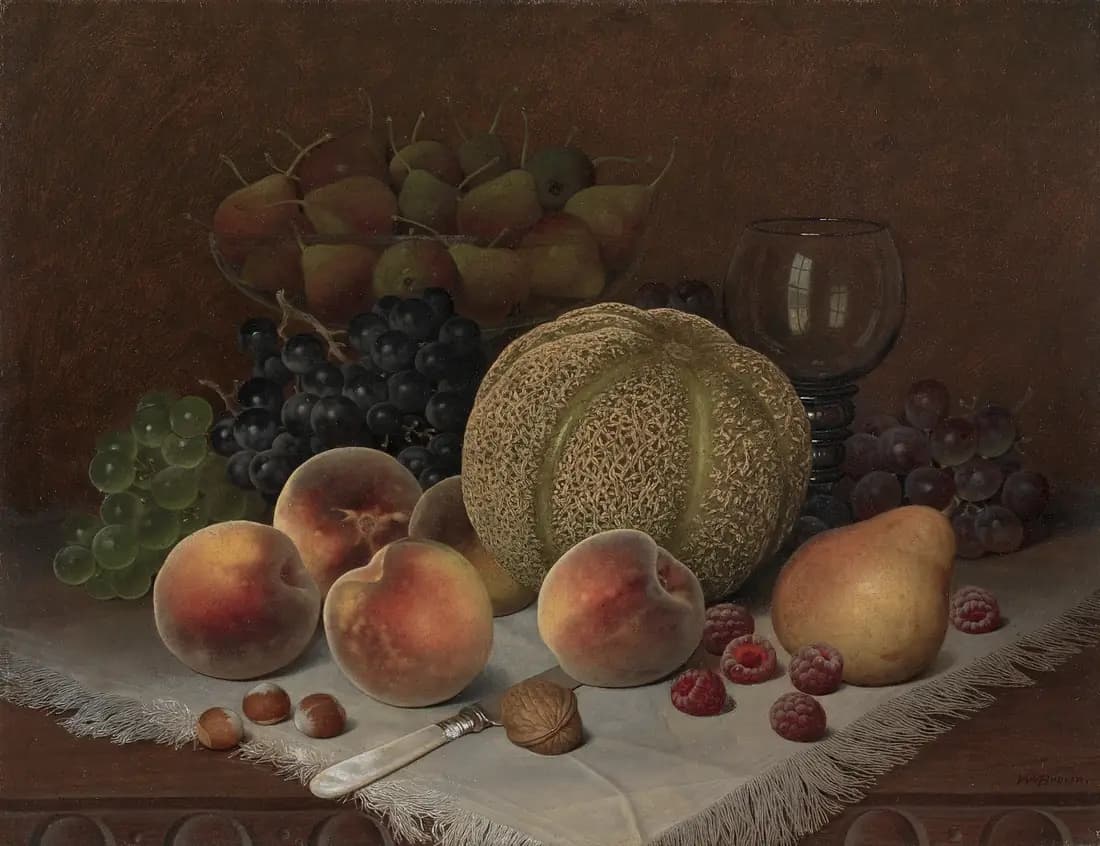
The largest object sits nearly at the center: a cantaloupe whose netted rind catches light without becoming smooth. Its scale and forward position make it the composition's anchor. Peaches overlap its base, while darker grapes and leaves gather behind it.
Brown avoids a rigid row by turning each fruit differently. Stem ends, rounded sides, and tilted axes make the arrangement feel handled and placed, not diagrammed.
Texture becomes the subject
Peach fuzz softens edges; grape skins hold small highlights; raspberries break into clustered beads. A knife, drinking glass, ceramic bowl, nuts, and fringed white cloth expand the comparison beyond fruit. Each material asks for a different kind of mark and reflection.
The Cleveland Museum emphasizes these contrasts. Brown's realism is persuasive not because everything is equally sharp, but because every surface behaves according to its own substance.
A landscape painter moves indoors
Brown began his career with portraits and spent much of the 1850s painting landscapes. After moving to Brooklyn in 1858, he increasingly turned toward still life. The Hudson River Museum describes that shift while noting the careful plants and rocks that had already distinguished his outdoor foregrounds.
Close observation therefore links the two phases. The eye once used to lead viewers across a landscape now travels across a tabletop, finding variety within a much shallower space.
Abundance hides its labor
Fruit still lifes were popular with nineteenth-century American collectors. A related museum account notes that Brown's ripe fruit was admired for meticulous pattern and texture, and that color reproductions carried such compositions to a broad audience.
The table offers abundance with no visible orchard, harvest, market, or kitchen work. That omission is part of the image's polish. Looking closely can recover some tension beneath the pleasure: cultivated things arrive as effortless plenty, while painting turns the labor of observation into an apparently natural feast.
Sources and further reading
- Cleveland Museum of Art collection recordExact work, objects, career shift, viewing angles, and contrasting textures.
- Hudson River Museum, William Mason BrownBrown's portrait and landscape beginnings, Brooklyn move, close observation, and shift to still life.
- St. Johnsbury Athenaeum, RaspberriesPopularity, texture, reproduction, and agricultural associations of Brown's fruit still lifes.