Look for the meal's missing people
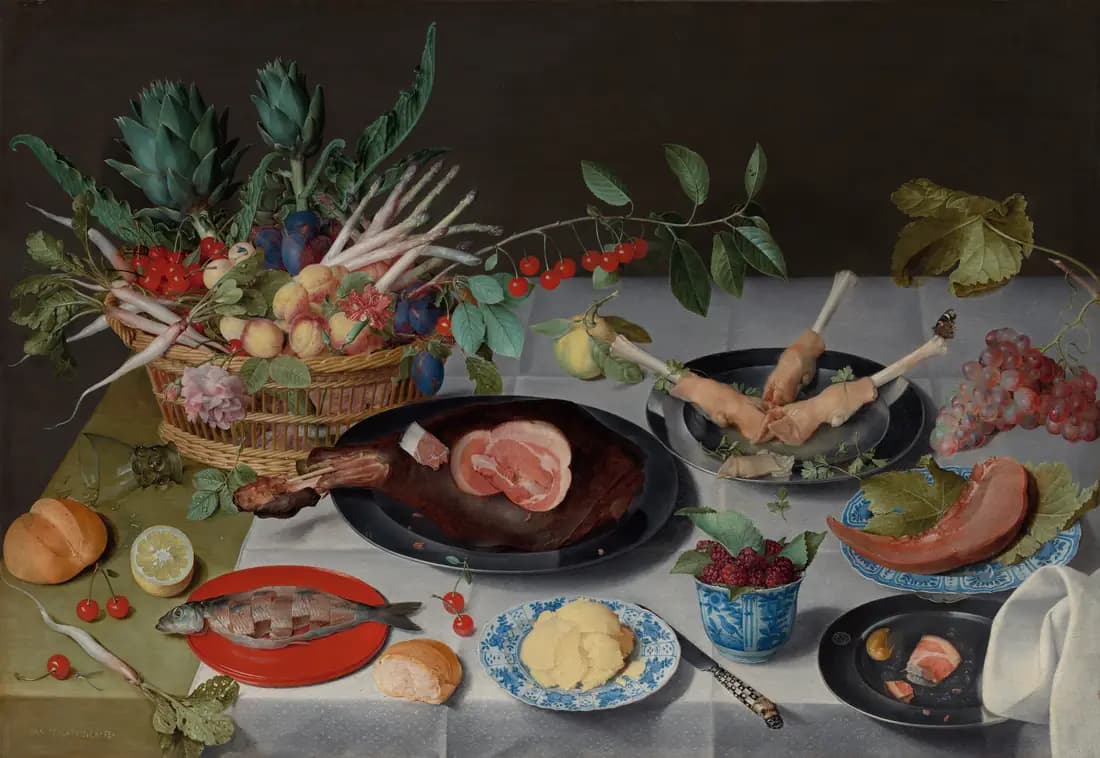
The table looks ready to overwhelm its guests. A dark ham anchors the center, fish and bright red plates press toward the front edge, and a basket rises behind fruit and vegetables. Yet this is not a display waiting to begin. The fish and meat have been cut, dishes disturbed, and one drinking glass knocked onto its side.
Tiny insects now occupy the food. Their arrival changes abundance into aftermath. Hulsdonck lets us infer a human scene without painting a single person: diners were here, they consumed part of the feast, and time has continued without them.
Every condiment has a job
The museum points out butter, lemon, parsley for the trotters, and a dab of mustard for the ham. These are not generic spots of color. They describe how the foods might be served and tasted, making the painting appeal to memory beyond sight.
Different surfaces invite the same close attention. Light slips across pewter, catches the wet interior of fish, settles softly on bread and fruit, and sharpens the blue decoration of porcelain. The painter turns a crowded inventory into a sequence of textures.
Luxury arrived from far away
Not everything on this Flemish table came from nearby. The delicate Chinese porcelain was an expensive product of international trade. Placed beside a plain earthenware trencher and metal dishes, it marks the household's reach into a much larger commercial world.
For a seventeenth-century viewer, the sheer variety could suggest an imagined world without hunger or scarcity. That fantasy is part of the work's force. The painting makes plenty convincing enough to touch while quietly revealing that such plenty depended on wealth, transport, and access.
An unusually ambitious Hulsdonck
Hulsdonck often painted concentrated arrangements such as one basket of fruit or one vase of flowers. The Cleveland Museum calls this early meal still life exceptionally large and elaborate within his work. Its broad panel allows many small specialist studies to coexist without losing the table's overall sweep.
The abundance is controlled by repetition: red returns in plates and fruit, pale circles recur in dishes and cut foods, and dark gaps prevent the objects from merging. The final surprise is that accumulation creates clarity. We can keep finding new things because each item has been given a distinct place.
Sources and further reading
- Cleveland Museum of Art collection recordExact object, foods, condiments, trade, abundance, insects, and material details.
- Cleveland Museum of Art, Acquisitions 2018The painting's scale, condition, date, and unusual ambition within Hulsdonck's still lifes.
- Cleveland Museum of Art, In the KitchenInstitutional close-looking prompts for the food, textures, sounds, and imagined senses.