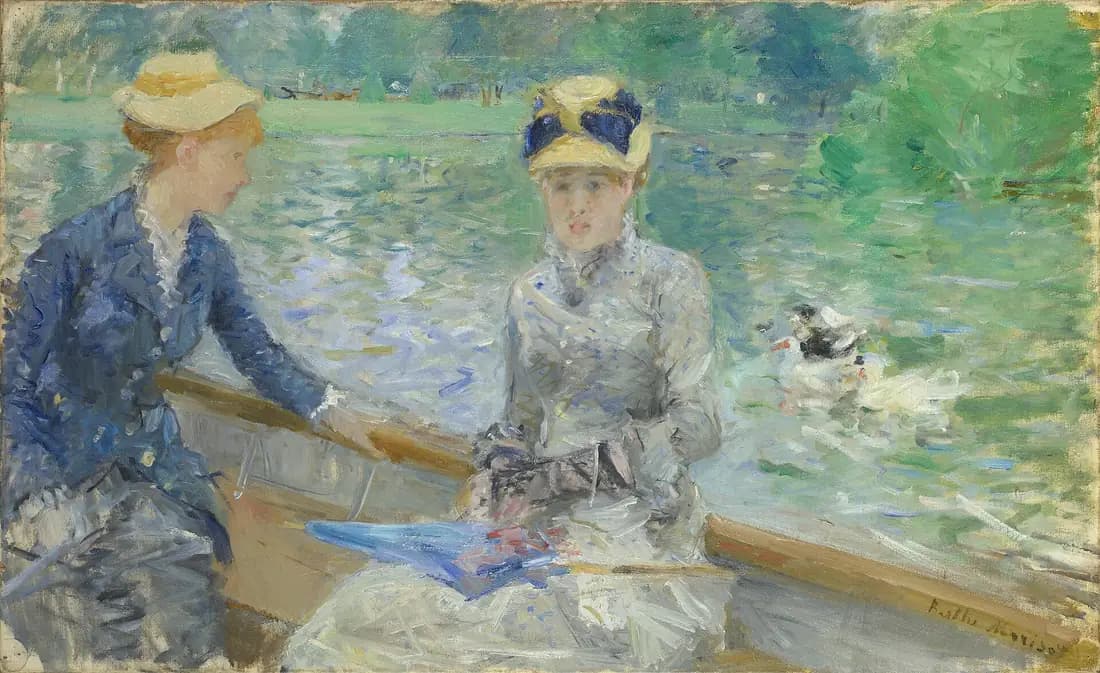
Two women, two directions
The figure at left looks toward us while her companion turns across the lake. Their fashionable hats and dresses mark a public outing, but Morisot avoids an easy social exchange. The closeness of the boat and difference of their gazes create a quiet tension at the centre.
A lake made from interruptions
Blue, green, white and brown strokes refuse to settle into a smooth mirror. Reflections fragment boats and trees, and ducks appear as dark accents near the hull. Morisot leaves some edges open, allowing the figures' clothing and the moving surface to meet without hard separation.
Modern leisure, closely observed
The Bois de Boulogne offered boating and promenades to fashionable Paris. Women's access to public space was nevertheless shaped by social rules and scrutiny. Morisot, one of the central Impressionists, makes the outing neither spectacle nor anecdote. She gives equal seriousness to clothing, posture, weather and the unstable act of seeing across water.
The lake is social space, not scenery
The women sit close to the water, but neither turns toward the landscape as a conventional viewer. One faces us while the other looks aside, making their relationship more important than the view. A railing slices diagonally between them and the lake, where boats become loose marks. Morisot turns a public outing into an ambiguous private interval.
Her handling changes across the canvas. Faces and clothing hold enough structure to register posture, while foliage, water and reflections loosen into touches of green, blue and white. The unfinished-looking energy was deliberate, not evidence that the image stopped early. It lets atmosphere press close to the figures. Their fashionable clothes place them in modern life, but the brushwork keeps that world from becoming fixed.
Sources and further reading
- National Gallery collection entryObject, location, figures and technique.
- National Gallery, Morisot artist recordInstitutional context for Morisot's work and career.