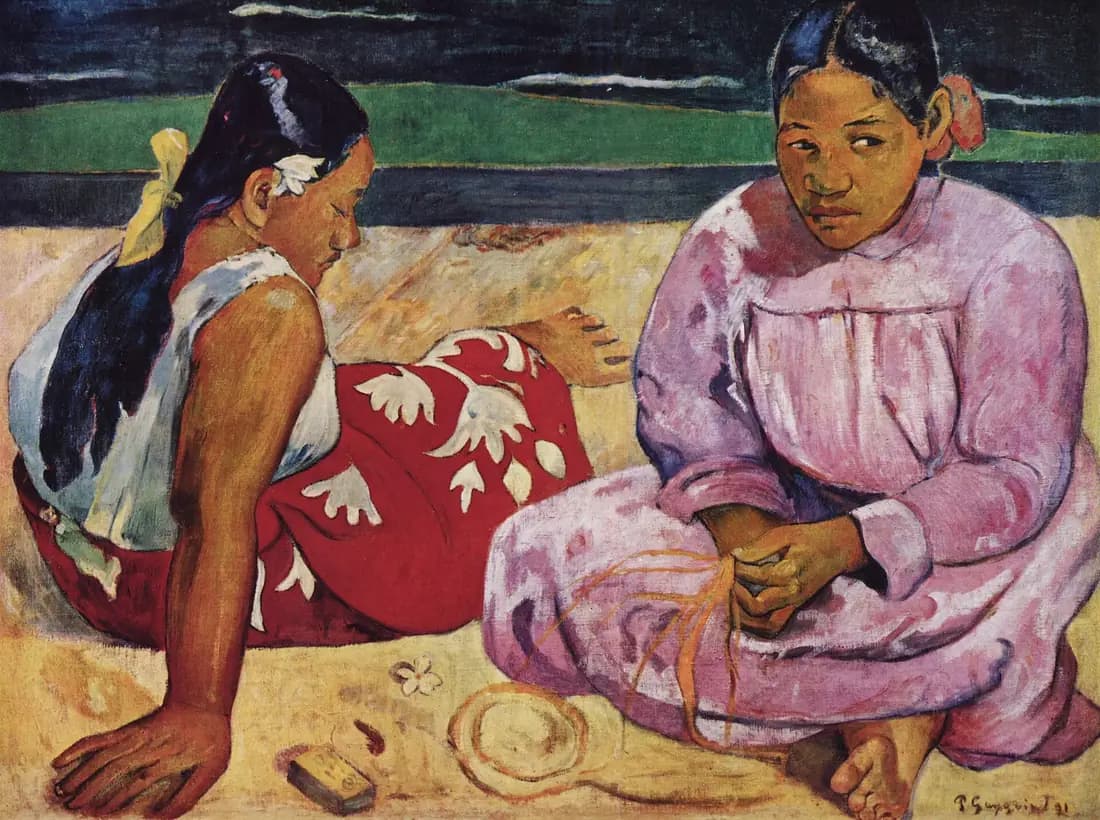
Two figures held in separate thoughts
The women occupy nearly the same shallow strip of shore. Their outlines and clothing create a compact arrangement, yet their turned heads resist a shared narrative. Gauguin gives the scene stillness by reducing gesture, depth and anecdotal detail.
Colour replaces conventional distance
Coral sand, dark sea, pink dress and ochre skin form broad adjoining areas. Shadows do not model every volume, and the beach rises behind the figures rather than opening into deep perspective. The surface owes something to Japanese prints and to Gauguin's search for a deliberately simplified visual language.
Looking through colonial invention
Gauguin left France expecting Tahiti to provide a supposedly untouched culture, although French colonial rule had already transformed the island. His paintings often mix observation with fantasies of an exotic, timeless place. Looking closely therefore means holding two truths together: the formal power of the picture and the unequal history through which its subjects were framed.
A quiet image shaped by unequal looking
The two women sit close but turn in different directions. One works with fibres or leaves, while the other rests with her face in profile. Broad shapes and subdued colour slow the scene, and Gauguin avoids a busy tropical setting. Their silence has often been admired as timeless, but it was created by an outsider choosing how Tahitian life would appear to European viewers.
That context changes the act of looking. Gauguin travelled under colonial rule and repeatedly transformed people he met into simplified types, sometimes mixing observation with fantasy. The painting can be studied for its strong contour, compressed space and restrained palette without treating its vision as transparent truth. Its calm is pictorially constructed, and the women’s own thoughts remain unavailable to us.
Sources and further reading
- Musée d'Orsay collection entryObject, date, subject and collection history.
- National Gallery of Art, Gauguin biographyInstitutional context for Tahiti, style and colonial history.