A five-mile race pivots on one pole
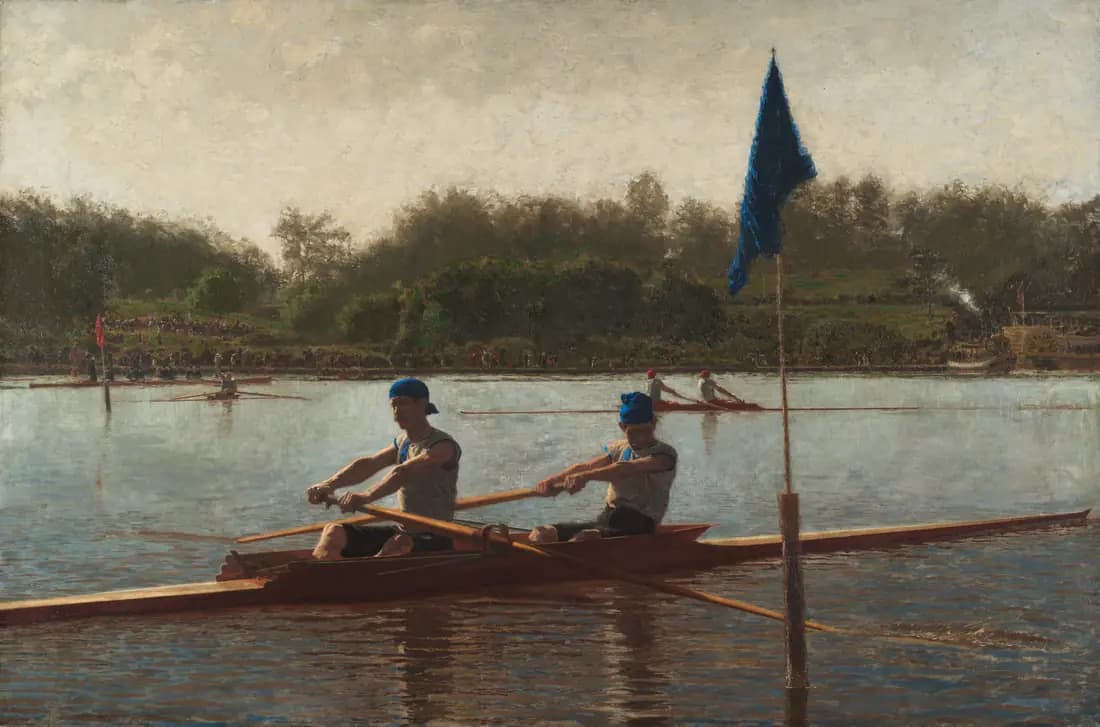
The blue flag marks the stake at the course's halfway point. John and Barney Biglin have pulled their long pair-oared shell almost alongside it and are beginning the difficult turn. Their competitors remain in the middle distance to the right. The brothers would complete the maneuver, win the May 1872 race on Philadelphia's Schuylkill River, and strengthen their reputation as leading professional oarsmen.
Eakins chooses the point when direction becomes unstable. The hull cuts across the canvas, the oars pull at different angles, and the stake stands rigid while boat and bodies rotate around it.
Two bodies have to become one machine
The brothers wear matching blue caps, but their poses are not identical. Each occupies a different moment in the stroke needed to steer the shell. A mistimed pull would waste force or upset the narrow boat. Their coordination is visible in the spacing of hands, backs, oars, and seats.
Eakins knew this movement from experience as a rower. He did not turn the athletes into remote classical heroes. Sunburned arms, workmanlike clothing, and concentrated posture make modern sport a subject serious enough for a large painting.
The tiny crowd explains the stakes
Spectators form a narrow band along the far bank, their bodies reduced to dark and light touches beneath the trees. Rowing drew enormous audiences in the United States after the Civil War, and the Biglins raced as professionals rather than private gentlemen. The distant gathering turns a quiet river into a public arena.
A second racing shell and smaller boats extend the event into depth. Eakins keeps the winners large and near, but the whole river participates through wakes, flags, hulls, and watching figures.
The instant was constructed slowly
The National Gallery of Art describes Eakins's rowing series as the product of unusually exact figure and perspective studies. He investigated boat dimensions, positions on the river, sunlight, and the geometry needed to join close bodies to deep space. The finished painting feels immediate because its structure is controlled, not because it was dashed off beside the race.
A related Eakins painting shows the brothers racing before the turn. Together the works behave almost like separate frames: approach, exertion, and then the risky change of direction. Painting could not record continuous motion, so Eakins selected the moments that make us reconstruct it.
Sources and further reading
- Cleveland Museum of Art collection recordExact painting, race, result, spectators, and Eakins's working method.
- National Gallery of Art, The Biglin Brothers RacingThe related race painting, professional rowing, the brothers' actions, and the five-mile event.
- National Gallery of Art, Thomas EakinsThe rowing series, preparatory studies, movement, and perspective.