A landing rather than a birth
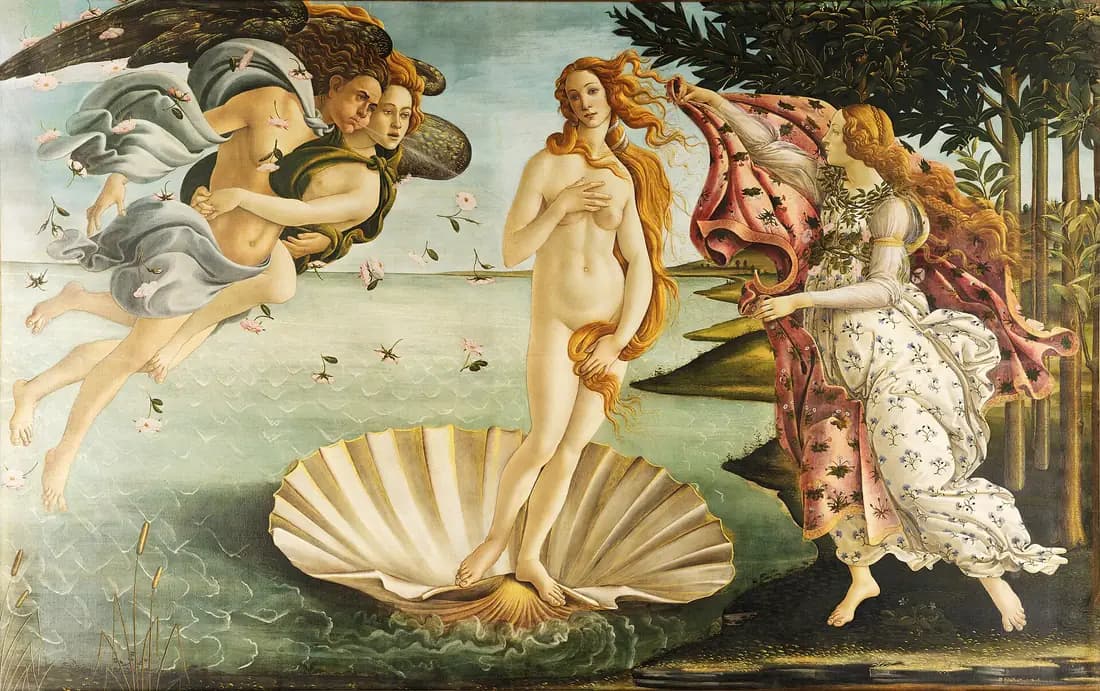
Classical myth tells how Venus arose from sea foam. Botticelli places her already formed on a shell, nearing the island of Cyprus. At left the winds Zephyr and Aura propel her forward; at right a Hora, associated with spring, waits to cover her. Roses scatter through the air as signs of the goddess.
A body drawn for the composition
Venus could not stand easily in this pose. Her weight and anatomy are deliberately elongated and unstable. The contour matters more than physical probability: pale skin makes a quiet vertical among curling hair, rippled water and wind-filled fabrics. That linear grace is one reason the image survives so powerfully at a distance.
Ancient story, Renaissance object
The painting was made on canvas, an unusual support for a work of this ambition in Florence. Its exact commission and first destination remain debated, although it was later documented with the Medici collection. Rather than treating every detail as a solved code, it is safer to see Botticelli joining classical poetry, contemporary beauty and decorative invention in a deliberately dreamlike shore.
Movement without naturalism
Venus’s body does not obey ordinary weight. She stands on the edge of a shell, her proportions lengthen elegantly and wind seems to carry rather than unbalance her. Botticelli chooses flowing contour over anatomical probability. Hair, drapery, waves and flying blossoms all participate in one patterned motion toward the shore.
That unity is easier to see if you ignore the identities for a moment. At left, intertwined bodies and breath push diagonally. At right, the waiting mantle creates an answering curve. Venus remains the pale vertical pause between those forces. The scene comes from classical myth, but its persuasive power is visual: opposed movements meet around a figure who seems both newly arrived and already iconic.
Sources and further reading
- Uffizi Galleries collection entryMythological figures, technique, dating and provenance.
- The Met, Botticelli and fifteenth-century FlorenceMuseum context for Botticelli and Florentine painting.